
.svg)
.svg)
.svg)
How do you find similar SaaS conferences faster?
Find similar SaaS conferences faster by starting with one known event or your role, then comparing options by audience fit, role fit, format, geography, and event season. From there, score each event by likely result, cost, travel effort, and meeting density so the shortlist stays practical and comparable.
Start With One Known SaaS Event or Your Role
Long conference lists slow the search because they flatten good options into one pile. We can move faster with one choice: if you already have a software as a service conference in mind, start there; if not, start with the role and outcome that matter most in the SaaS industry.
- If you can picture the room, attendee mix, and likely payoff, branch from that event first.
- If the brand matters less than who you need to meet, use role-first routing and follow the events that fit that job.
- Then take that branch into the next filter to judge which events are worth the trip and budget.
Use a Known Conference to Branch Faster
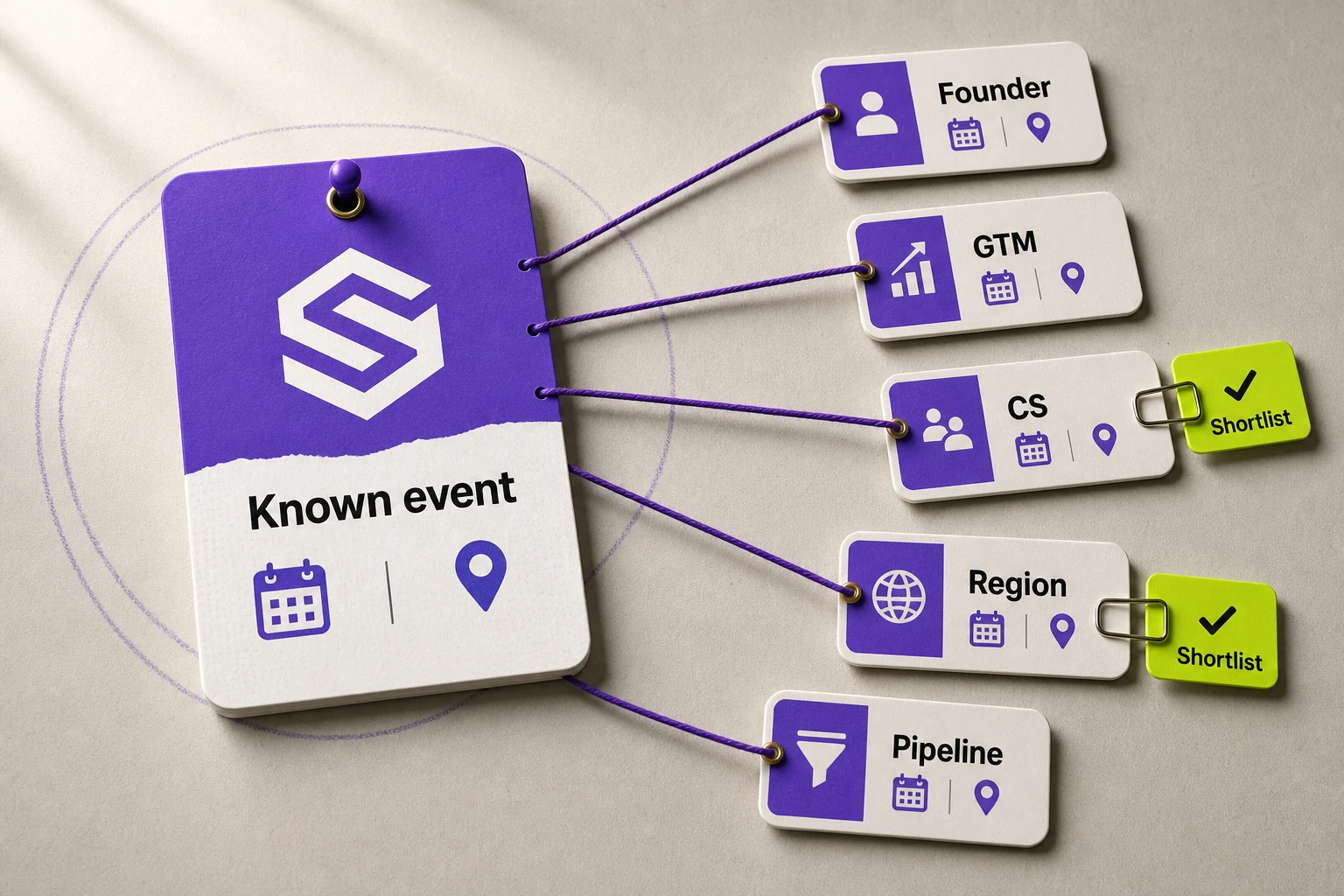
A familiar event gives the search a reference point instead of a blank page. Known-event branching means using one conference as a pattern: check who attends, how big it feels, and what people usually go there to get done. That turns one memory into a repeatable filter.
- Audience Fit: if the known event skews toward founders, revenue leaders, or technical teams, look for similar attendee mixes before speaker lists.
- Scale: if the event works because it is compact and meeting-heavy, branch toward smaller gatherings; if the value comes from broad exposure, branch toward larger multi-track conferences.
- Outcome Fit: compare whether the event is best for fundraising, partnerships, recruiting, customer conversations, or product learning, then keep only similar event types in the next pass.
Jump to the Role That Fits You
When no single conference stands out, role-first routing is usually faster. The right filter is not the loudest brand. It is audience fit and outcome fit for the people who need the trip to produce something useful.
| Role | What to optimise for | What that usually means in events |
|---|---|---|
| Founders | Fundraising, partnerships, category visibility | Rooms with investors, senior operators, and strategic peer conversations |
| Operators | Playbooks, hiring, revenue workflow, peer problem-solving | Sessions and side meetings built for implementation, not just inspiration |
| Investors | Early market signal, founder quality, category momentum | Events where company mix and off-stage conversations reveal trends early |
| Enterprise buyers | Vendor evaluation, peer validation, practical use cases | Events where buyer conversations are direct and operational |
| Developers | Technical depth, architecture choices, product craft | Events with stronger technical sessions and practitioner-heavy attendance |
| AI leaders | Applied AI strategy, tooling choices, governance questions | Events where ai leaders can compare real deployment lessons, not only vision themes |
How to Choose the Best SaaS Conferences
Once the reader has a starting point, the next question is whether an event is worth the trip. The best SaaS conferences are not always the biggest names. Treat SaaS conferences as a business choice: score each option by likely result, cost, travel effort, and access quality. A smaller event can beat the larger best events when the fit is tighter.
| What to score | What it asks | Why it matters |
|---|---|---|
| Outcome fit | What result should this event help produce? | Events should match the real goal, not prestige. |
| Real cost | What will attendance consume in cash and team time? | Conferences compete with other work. |
| Travel friction | How much effort does the trip add? | A harder trip raises the return required. |
| Meeting density | How many useful conversations are likely in person? | Thin access rarely justifies the effort. |
Score Each Event by Outcome and Cost
Prestige is a weak shortcut because it says little about likely return. Conference scoring works better when each event is judged against the same criteria. The goal is not a perfect formula. It is to make trade-offs visible before time and budget disappear.
| Criterion | What to look for | High score signal | Low score signal |
|---|---|---|---|
| Outcome fit | Does the audience match the intended business result? | The room is likely to produce the meetings, learning, or visibility the team wants. | The audience is broad, but the likely outcome is vague. |
| Total cost | What is the full spend after tickets, travel, time away, and follow-up? | The event is affordable relative to the expected return. | The spend is heavy, and follow-through will be weak. |
| Travel burden | How much energy does the trip consume before and after the event? | Travel is straightforward and does not disrupt core work for long. | Travel is complex or costly enough to erode the value. |
| Meeting density | How many worthwhile conversations are likely in a short window? | The format makes it easy to stack relevant meetings. | Useful conversations will be scattered or hard to schedule. |
Filter by Travel Time and Meeting Density
Travel friction belongs in the decision from the start, not as an afterthought once tickets are booked. A long journey can still be worth it when the event creates concentrated, in person access to the right people. If the schedule looks thin, the room feels loosely matched, or most of the useful conversations could happen remotely, face to face access is probably not dense enough to justify the trip.
Travel friction belongs in the decision from the start, not as an afterthought once tickets are booked.
- Go when the conferences under review give the team a realistic chance to cluster relevant meetings into a short window.
- Go when the event format supports repeated in person contact, not just passive session attendance.
- No-go when travel time overwhelms the likely value of the conversations that can happen face to face.
- No-go when the event looks impressive on paper, but the meeting density is too low to create real follow-up momentum.
We can carry this same filter into founder-focused conference types next, so the shortlist stays consistent instead of resetting around brand recognition.
Best SaaS Conferences for SaaS Founders
Once the scoring framework is clear, the founder question becomes simpler: what is the company trying to achieve right now? For SaaS founders, the best SaaS conferences are rarely the biggest or loudest SaaS events. The better filter is founder objective. Some SaaS conferences are better for investor access, some help SaaS leaders build category visibility, and others are stronger for peer learning with industry leaders facing similar operating pressure. Sort conferences by that outcome first, and top SaaS events become easier to spot.
For Fundraising and Investor Access
Founders looking for capital should not treat every premier event as a fundraising room. The useful signal is investor proximity: are potential investors easy to meet? Are there enough founder-to-founder conversations to compare fundraising context? And do fireside chats, side meetings, and smaller gatherings create warmer openings than a crowded expo floor? That is what makes one set of conferences more comparable than another.
| Room trait | What it usually signals | Likely founder payoff |
|---|---|---|
| High investor proximity | Investors are present in visible meeting areas, roundtables, or curated side events | More direct access to potential investors and faster qualification of whether the room fits the current raise |
| High founder density | Many venture-backed or actively fundraising founders are in the same events | Better calibration on pitch positioning, valuation climate, and who is taking meetings |
| Warmer conversation format | Fireside chats, hosted dinners, and smaller networking blocks create repeat touchpoints | More natural follow-up conversations than a room built mainly for broad exposure |
| Open floor, low context | Large events with broad attendance but little investor structure | Useful for awareness, but weaker if the immediate goal is fundraising access |
Quick caution: naming specific investor-heavy events would require current attendee verification, so the safer move is to judge room traits rather than assume a conference still has the same capital mix. If the near-term goal is a raise, compare events by conversation warmth first, then by brand recognition.
For Partnerships and Category Visibility
Some founder rooms matter less for capital and more for distribution. When the goal is strategic partnerships, category visibility, or a clearer market position, the best-fit events usually attract ecosystem players, adjacent platforms, and buyers who influence reputation even if they are not writing cheques. That changes what a comparable room looks like.
- Goal Fit: choose events where partnership conversations can turn into channel access, integrations, or co-marketing, rather than default networking.
- Stage Fit: earlier-stage companies often need credibility and introductions, while later-stage teams may look for larger ecosystem reach and repeatable partner motion.
- Conversation Type: the useful signals are practical meetings about strategic partnerships, market overlap, and who can help extend distribution or trust.
- Visibility Test: category visibility improves when the room helps founders explain what makes the company distinct, not just visible to more people.
For Scaling SaaS Companies
Once a company is past early positioning, founder value often comes from the quality of the scaling-stage room. For SaaS companies, these events are less about headline access and more about whether other founders and operators in the SaaS community are dealing with the same challenges in pricing, hiring, retention, and capital efficiency. That is where comparison gets practical.
- Goal Fit: prioritise events where SaaS businesses can pressure-test growth strategies, compare growth challenges, and share ideas that support sustainable growth.
- Stage Fit: the strongest rooms for software businesses usually have peers facing similar scale, team complexity, and board pressure, not just ambitious early-stage energy.
- Conversation Type: look for honest conversations, unfiltered stories, and operator-level detail that other founders can use quickly.
- Community Signal: a community-driven event with a great community often produces more repeat value than a broad room with weak relevance.
That founder objective lens also sets up the next decision: operators need a different event mix, because pipeline, retention, and execution goals change what counts as a worthwhile room.
Go to Market and Customer Success Picks
Founder-focused events answer one set of questions. Operator value is narrower and more practical: can the team leave with better conversations, better retention instincts, or a clearer execution workflow? For go to market teams, marketing professionals, and customer success leads in B2B SaaS, the best events are not just busy. They help the team decide which rooms are built for pipeline, which ones sharpen post-sale judgment, and which ones turn peer tactics into usable next steps.
Events for Pipeline and Book Meetings
Some conferences feel active without producing much commercial follow-through. A useful pipeline room creates enough structure for the team to book meetings, qualify new connections, and leave with meaningful connections rather than a stack of vague chats. The test is simple: the event should make revenue conversations easier to start and easier to continue after the conference ends.
- Clear attendee clustering by role or segment, so the team can identify relevant prospects instead of sorting through a mixed crowd.
- Enough breaks, hosted meetups, or side events to create repeat contact points without relying on hallway luck alone.
- A strong bias toward introductions, demos, or follow-up conversations, which makes it easier to book meetings before and during the event.
- Conversation settings that support practical qualification, not just stage energy or broad networking opportunities.
- A crowd that helps the team build new connections across adjacent partners, prospects, and peers, and not only collect badge scans.
- A conference design that gives people reasons to reconnect after the first exchange, which creates fantastic networking opportunities that feel more like working conversations than crowd buzz.
Events for Retention and Customer Insight
Top-of-funnel energy is not the same thing as retention value. The best events for customer success and post-sale teams surface the reasons accounts expand, stall, or churn, then turn those patterns into better handoffs, onboarding, and account management choices. That is where retention signal becomes useful.
- Sessions focus on adoption, renewal risk, onboarding friction, or customer education rather than pure lead generation.
- Panels and breakouts include operators discussing what changed after launch, not just how they won the deal.
- The room attracts practitioners close to the customer, which makes the conferences better for hearing objections, usage patterns, and expansion triggers.
- Discussions reveal churn-reduction signals early, such as where expectations slip, where activation slows, and where support patterns expose product gaps.
- The event leaves the team with customer insight they can feed back into messaging, implementation, and account planning.
Events for Operator Playbooks
A playbook event earns its place when peers explain what they actually changed, in what order, and what the trade-offs looked like. Picture a mid-sized B2B SaaS operator event built around small-group sessions instead of headline-heavy keynotes. One roundtable discussions session is led by growth leaders comparing pipeline handoffs, another breaks down onboarding fixes, and a third focuses on how teams share insights across sales, success, and product. What makes that setup useful is the structure: each room stays close to one operating problem, peers can challenge what did not work, and the conversation moves from broad advice to steps a team could test the following week. That is usually the sign to look for in similar events. If the sessions force people to explain the trigger, the change, and the result, the room is more likely to produce actionable insights, a few new ideas worth testing, and a clearer sense of which tactics travel well to your own workflow.
Conference Picks for Investors and Enterprise Buyers
Once the operator lens is clear, the next split is tighter. Investors and enterprise buyers do not need the loudest room or the broadest conference brand. They need signal-rich rooms where the quality of founders, category conversations, and commercial context makes it easier to judge momentum, vendor fit, and which discussions are worth pursuing further.
Where to Spot Market Signal Early
An early signal is rarely about one flashy talk. A signal-rich room helps investors stay ahead by showing where founder energy, buyer curiosity, and category movement are starting to align across events and conferences.
- Founder quality is visible in the specificity of the problem being discussed, not just the polish of the pitch.
- Category momentum shows up when multiple conversations point to the same buyer pain, workflow shift, or emerging product approach.
- Buyer presence matters because it tests whether the market story connects to real purchasing interest.
- The best rooms surface the latest trends through repeated patterns, not through one prediction from the stage.
- A useful signal-rich room helps investors notice which companies feel like the next generation and which ones are repeating last year's language.
Where Buyer Conversations Matter Most
Buyer relevance depends less on popularity and more on who is in the room, how discussions happen, and whether the vendors present match the buying context. We can compare conference types and events on those three points without making unverified claims about any one event's attendee mix or vendor roster.
| Conference type | Attendee type | Conversation quality | Vendor relevance |
|---|---|---|---|
| Executive-led industry gathering | More senior leaders and enterprise decision makers | Higher-level problem framing, budget context, and evaluation language | Stronger when technology providers map clearly to enterprise priorities |
| Operator-heavy SaaS meetup | Functional managers, team leads, and selected decision makers | More candid workflow detail and implementation friction | Useful when vendors support day-to-day operating needs |
| Partner and ecosystem event | Advisers, integrators, buyers, and selected providers | Good for scoped conversations shaped by fit and compatibility | Best when technology providers depend on partnerships or adjacent systems |
Conference Picks for Developers and AI Leaders
After the founder, operator, and buyer filters, the next decision is more practical: which events will actually help your team work better once you are back in the office. Developers and AI leaders usually get more value from the right events when the agenda shows technical depth, working sessions, and proof that the topic goes beyond broad business positioning. Use this branch as a simple review process: check for implementation detail and workshop quality first, then test whether any AI theme materially changes what the event helps teams build or run.
Events With Deeper Technical Sessions
Technical teams rarely get much from a conference that stays at trend level. The useful test is agenda depth: sessions should show how teams built something, where implementation became difficult, what trade-offs shaped the outcome, and whether attendees can question the people who did the work. That is what turns technical depth into something a team can carry back into its workflow.
For product leaders, engineering managers, and architects, the better fit usually comes from a tighter practitioner mix. Strong signals include hands on workshops, narrow breakouts, and talks led by operators or industry experts who can explain system choices, tooling limits, rollout problems, and lessons from production. A conference can still include business content, but the technical track should stand on its own.
- Look for session titles that describe a build, migration, integration, or operating problem rather than a broad future-of-tech theme.
- Prioritise hands on workshops or live walkthroughs that let attendees examine implementation detail instead of only hearing strategy summaries.
- Check whether speakers appear to be practitioners from product, engineering, platform, or data teams, not only executives giving market commentary.
- Favour events where Q&A, roundtables, or small group formats make it easier to pressure-test methods with peers.
- Treat broad business programming as secondary if the main goal is technical learning and repeatable operator playbooks.
Events With Stronger AI Focus
An AI label may broaden interest, but it does not automatically make a conference useful. Substantive AI relevance appears when AI changes the agenda itself: sessions move past branding language into workflows, model choices, governance questions, integration constraints, evaluation methods, and the operational realities teams manage after launch. That is the difference between trend watching and leaving with something a team can apply.
- Real SaaS and AI relevance usually includes applied sessions on implementation, measurement, safety, deployment, or product change, not only keynote-level excitement.
- Useful events for AI founders often connect technical work to product and commercial decisions without replacing technical substance with market theatre.
- A stronger fit for SaaS and AI founders appears when the agenda shows repeated AI treatment across product, engineering, data, and operations, rather than one isolated track.
- Superficial branding often looks like a renamed event page, a handful of AI sessions, or vague claims about transformation with little evidence of practitioner depth.
- Before choosing among conferences, verify the current agenda, speaker list, and track structure directly. Any named-event claim about present AI depth or session mix needs fresh confirmation.
That filter sets up the next choice: not just which events to attend, but how to show up once the shortlist is clear.
Speaking and Sponsoring SaaS Events That Matter
Once the right conference type is clear, the next decision is how to show up. Attendance, sponsorship, and speaking can all matter at SaaS events, but they create different returns: authority shapes trust, access improves introductions, and reach expands awareness across the room.
Once the right conference type is clear, the next decision is how to show up.
- Authority: best when the goal is to teach, frame a category, or earn credibility before a sales conversation starts.
- Access: best when the goal is warmer introductions, partner conversations, or repeat contact with the right people at events and conferences.
- Reach: best when the goal is broad visibility across SaaS events, especially when the brand needs to be seen before it can be seriously considered.
Where Partner Visibility Pays Off
Partner visibility earns its keep when it helps the team show up in more conversations than a ticket alone would allow. The real value is rarely logo exposure by itself. It comes from being easier to notice, easier to trust, and easier to mention when someone is making introductions.
- Choose it when the event runs on an ecosystem model, and referrals from agencies, platforms, investors, or service partners can create lasting relationships.
- Choose it when the team already knows who it wants to meet, and brand visibility makes those meetings easier to start and easier to follow up after the event.
- Choose it when repeat presence matters. Seeing the same partner across several touchpoints can build familiarity faster than one-off networking.
- Skip it when the goal is vague awareness, the team has no meeting plan, or success depends on package promises that are not currently verified by the organiser.
Where Speaking Beats Booth Spend
Speaking usually wins when trust has to form before a buyer, partner, or peer wants a deeper conversation. A session creates authority in a way booth spend often cannot, especially when the team has a sharp point of view or useful operating lessons to share. We should keep the comparison conceptual, though: any claim about speaking slots, acceptance odds, sponsor cost, package inclusions, or measured outcomes needs current confirmation from the organiser.
| Decision area | Speaking | Booth spend |
|---|---|---|
| Primary advantage | Builds thought leadership and trust through ideas, examples, or panel discussions | Builds visibility and makes the brand easier to spot on the floor |
| Best use case | The team has a strong lesson, contrarian view, or category point to teach at events | The team needs repeated exposure, easier wayfinding, or a visible base for meetings |
| Stronger return when | Authority matters more than volume, and conversations depend on credibility first | Reach and access matter more than teaching, and the team already has outreach or meetings lined up |
| Main limit | Current speaking slots, selection process, and event-specific outcomes need official verification | Current booth spend, package details, and sponsor outcomes need official verification |
Find Similar SaaS Events by Region and Timing
Once the reader knows which conference style fits the goal, the next bottleneck is practical: which options are close enough, timed well enough, and similar enough to compare. We can narrow SaaS events faster by starting from one familiar event, then filtering by audience, role fit, format, geography, and event season. That keeps the search grounded in real constraints instead of a long scan of events.
- If one known event is the starting point, look for a comparable event with a similar audience mix, session depth, and meeting style.
- If travel is the hard limit, start with regional narrowing first, then compare SaaS events in that geography by role fit and format.
- If timing is the blocker, start with event season, then keep only the events that match the team’s calendar window.
If You Know One Event, Start Here
A familiar conference gives the search a working benchmark. Instead of asking for the best option in the abstract, the team can ask which events feel comparable in audience, operator depth, investor presence, or meeting intensity.
Start with Web Summit if that is the event your team remembers: broad, high-volume, and useful for wide exposure, but too general for deep SaaS conversations. Then narrow by workflow, not fame. Look for events with a tighter software audience, more SaaS-specific sessions, and a stronger chance of repeated founder or operator meetings.
Use the same screen if SaaStr Annual is the benchmark instead. If the draw is concentrated software conversations, later-stage operators, and denser networking, keep those traits fixed and compare alternatives against them first. A comparable event is defined by audience mix, role fit, and format, not size alone.
- Audience Cue: broad cross-industry crowd or software-heavy crowd.
- Role Cue: founder, revenue leader, product operator, investor, or technical lead.
- Format Cue: large expo, curated summit, workshop-heavy programme, or meeting-led environment.
- Constraint Cue: same region, easier flight pattern, or a better calendar slot.
That shortcut makes similar events easier to spot without expecting a live recommendation list.
Browse by Region and Event Season
Geography and calendar windows often remove more options than preference alone. A team that wants West Coast access, a San Francisco Bay Area network, or a shorter flight path should browse by scenario, not brand. Treat places such as San Francisco, the San Francisco Bay, Las Vegas, or a venue reference like Palmer Events Center as location signals, not current scheduling claims. The same filter works for quarter timing and community events.
| Starting constraint | What to browse for | What makes an event comparable |
|---|---|---|
| Nearby region | Events in one reachable geography such as the San Francisco Bay Area or Las Vegas | Similar audience, role mix, and a format that justifies the trip |
| Specific city network | Events tied to one local hub such as San Francisco or another repeat travel base | Stronger meeting density, easier follow-up, and lower travel friction |
| Seasonal window | Events that fall inside one realistic quarter or lighter operating period | Timing that fits the team calendar without forcing a rushed trip |
| Venue-led memory | Events associated with a remembered venue or city marker such as Palmer Events Center | A recognisable location anchor that helps the team rediscover similar options |
| Community-first preference | Community events with smaller rooms or tighter peer access | Higher conversation quality even if the event has less broad visibility |
This structure is meant to narrow, not to serve as a live directory. Once the options fit the right region, event season, and comparable-event profile, the next step is to choose which one to three deserve a place in the calendar.
Plan Your Year for Attending SaaS Conferences
Once the field is narrow, the next move is commitment. We can build a simple annual plan by giving each event one clear job, keeping the list to one to three conferences, and checking whether attending SaaS conferences still works once travel load, total team effort, and the business case are in view. That turns broad SaaS conferences research into a short list of events you can actually support.
Build a Shortlist of One to Three
A workable annual shortlist stays small because each event should do a different kind of work. If two options create the same meetings, reach the same audience, and demand the same follow-up, one of them is probably noise rather than one of the right events.
- Assign each event a distinct job, such as pipeline meetings, investor conversations, partner visibility, or operator learning.
- Keep only events that serve different outcomes. If two events promise the same result, keep the one with the stronger fit.
- Check whether the audience matches the team actually attending, rather than the team that wishes it could attend.
- Confirm that the event timing supports follow-up, not just attendance. A crowded quarter can erase the value of good meetings.
- Ask what would make this event a clear win before committing. If the answer is vague, remove it from the annual shortlist.
- Stop at one to three events total unless separate teams have separate goals and follow-up capacity.
Match Budget to the Right Event Mix
A good plan can still break if every event asks for the same spend and the same team energy. Without verified current pricing, the safer move is to compare your event mix qualitatively: total spend, travel load, and whether each choice earns a separate outcome.
- Use one flagship event when broad exposure or higher meeting density is the main goal.
- Add one smaller targeted event when the team needs sharper conversations or easier follow-up.
- Compare the full event mix by pass cost, travel burden, and time away from normal workflow, even without exact figures.
- Avoid stacking multiple high-effort events that chase the same result.
- Treat expected return as company-specific. If attribution is weak, choose the simpler mix the team can support after the conference.
Keep the closing rule simple: choose an annual short-list of one to three events, give each one a distinct event job, and back the event mix your team can follow through on well.