
.svg)
.svg)
.svg)
Which SEO trends will still matter after the hype fades?
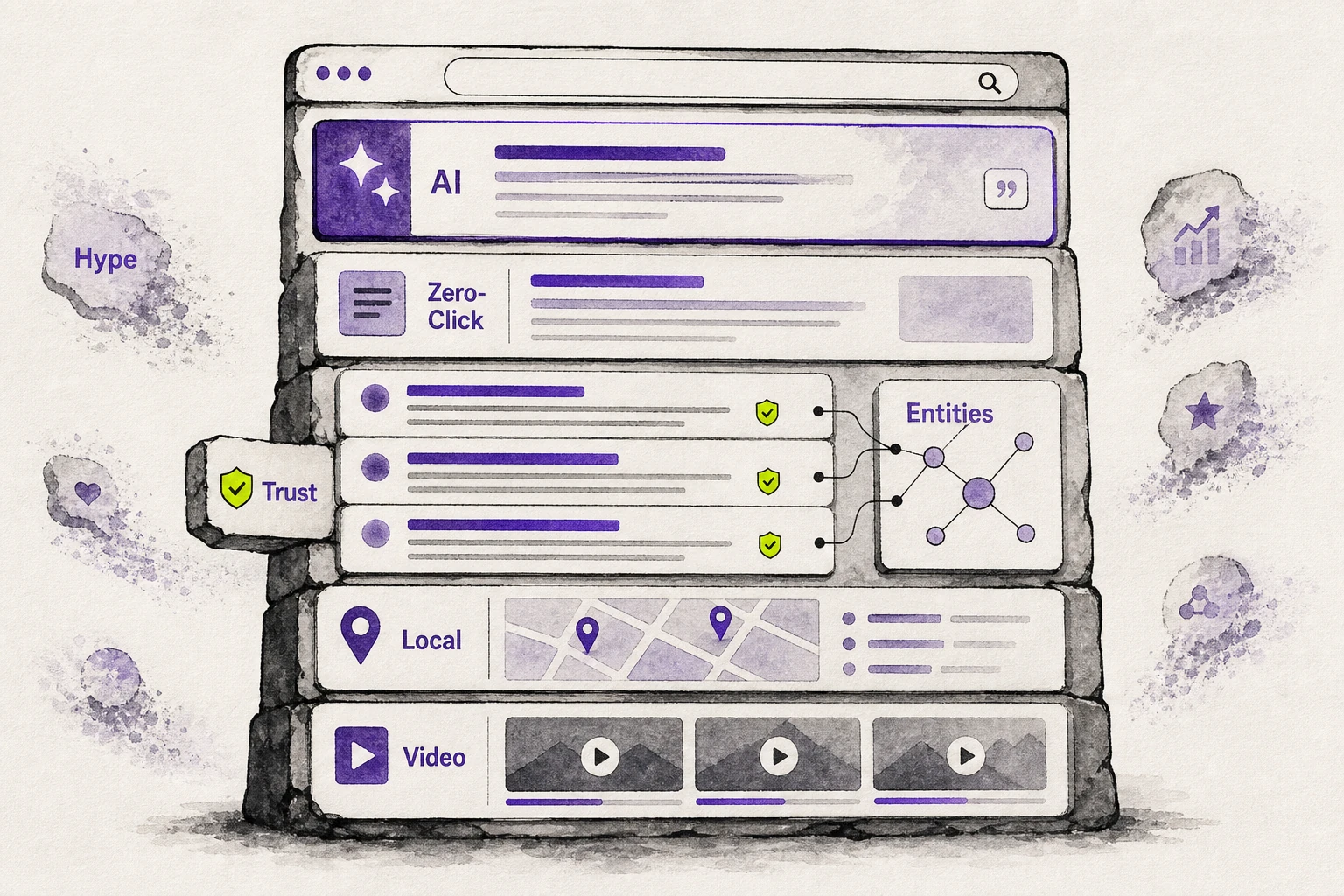
The SEO trends most likely to last are shifts that change user behavior, platform economics, or retrieval architecture. In practice, that means AI search result layers, zero-click visibility, trust validation through E-E-A-T, structured data and entity signals, and channels like local SEO and video where users still need verification or demonstration.
SEO Trends That Still Matter in 2026 and How to Separate Structural Shifts From Hype
Most SEO chatter confuses novelty with structural change. A real durability test asks a harder question: does a shift alter how people discover information, how platforms ration attention, or how retrieval systems decide what gets surfaced and trusted? Judge each trend against user behavior, platform economics, and retrieval architecture, not novelty alone. If the answer is no, the trend is usually just motion inside the SEO industry, not a durable change in search engine optimization. That distinction matters because many of the latest SEO trends attract budget long before they earn durable strategic weight. The same inflation happens when top SEO trends are treated as destiny before they change anything fundamental. A trend that cannot change behavior, economics, or retrieval logic may still generate noise, dashboards, and pitch decks. It rarely deserves long-term SEO lead attention.
- User Behavior: If people still search, scan, and choose in roughly the same way, the supposed shift has not really moved power. It may create new chatter around SEO trends, but it has not changed the reader's habits enough to matter.
- Platform Economics: Durable change shows up when the rewards move. If the results page, the visibility winners, and the traffic value chain all stay mostly intact, the excitement is cosmetic, not structural.
- Retrieval Architecture: The deepest shifts change how systems read meaning, entities, trust, and relevance. A tactic that only speeds up production may make the SEO industry feel busier while leaving the actual logic of retrieval in place.
- Persistence: A real shift keeps exerting pressure after the novelty spike fades. If attention disappears as soon as the branding cycle moves on, the trend never deserved long-term authority in search engine optimization.
- Reallocation Pressure: Structural change forces a tradeoff. Teams have to move time, budget, or editorial judgment away from something else; if no sacrifice or loss of control appears, the change is probably superficial.
Trend 1: AI Search Engines Are Rewriting Search Results, Not Just Content Workflows
AI search engines matter because they are changing where attention stops, not merely how fast publishers can produce copy. The durable shift sits in the search results themselves. An answer layer can now sit between the query and the visit, compressing comparison, summary, and synthesis into the page before a user ever chooses among links. That changes how search engines distribute attention, and it changes what visibility means inside search results.
Consider a generic product-comparison query. Traditional search results asked the user to scan titles, open several pages, and assemble an answer alone. In AI search, the page can do that synthesis first through answer boxes and similar layers, drawing from multiple sources and leaving only a smaller share of users to click through. The structural point is the same across AI Overviews, Google AI Mode, AI Mode, Google's AI Overviews, and features used by other search engines: first attention is being intercepted upstream, and AI visibility is being contested before the visit. That is why AI search optimization is becoming a visibility problem before it becomes a publishing problem.
Why AI Search Results Change Discovery Economics
AI search results do not just rearrange traffic. They weaken the old bargain that high placement in search results earns the first encounter, the first judgment, and often the first measure of trust. A page can now inform the answer without receiving the visit. In that environment, search rankings still matter, but they no longer guarantee first contact, and sometimes they do not guarantee contact at all. The winning asset is not just a page that exists in search results. It is a page whose information can be extracted, trusted, and reused inside AI generated responses.
That shifts value toward legibility, but it also shifts control away from the publisher. AI systems and AI engines need material they can parse, compare, and summarize without confusion, while users increasingly form their impression from AI responses before they ever reach the source. So the commercial question changes. Instead of asking only whether a page ranks, teams have to ask whether it travels well inside AI responses, whether it survives compression into AI generated summaries, and whether enough attribution remains to preserve future demand. Discovery has become less about occupying a slot and more about being reusable inside AI search results.
Discovery has become less about occupying a slot and more about being reusable inside AI search results.
What Still Matters From Traditional SEO
Traditional SEO did not become obsolete when answer layers arrived. It became infrastructure. If AI tools are deciding what to surface, summarize, or trust from web pages, they still need pages that are accessible, intelligible, and credible in the first place. The basics remain foundational because machine mediation raises the penalty for ambiguity and weak structure rather than removing it.
- Preserve crawlability. If a page cannot be reached and processed reliably, neither traditional SEO nor AI-mediated discovery can build from it.
- Keep site architecture clear. Strong internal structure helps important pages signal what they are, how they relate, and why they deserve attention.
- Maintain relevance at the page level. Pages still need to answer a real query cleanly, with language and scope that match user intent.
- Protect authority. Sources, authorship, and overall site credibility still shape whether information looks safe to reuse or cite.
- Treat technical SEO as interpretability, not housekeeping. Clean markup, stable rendering, and coherent page signals make web pages easier to understand and reuse.
The old foundation still governs the new layer. The next question is harder: if visibility can rise even when visits do not, what exactly should count as SEO value now?
Trend 2: Zero-Click Search and Featured Snippets Grow as More Queries End on the SERP
More search journeys now end before a visit begins. That shift is not just about lost traffic from AI generated summaries or other AI answer layers. It reflects a broader change in search behavior across results pages, where direct answers, featured snippets, and compressed interfaces often resolve simple intent on the spot. A searcher who wants a definition, a quick comparison, a formula, a date, or a short procedural check may never need to leave the SERP. The old assumption that visibility matters only when it produces an immediate click is becoming less useful.
Take a simple query such as "what is canonical tag". A searcher can see AI summaries, featured snippets, and other direct answers near the top of the page, get the core explanation, compare a few sources, and move on. In that moment, zero click searches are not a tracking anomaly. They are SERP satisfaction. The result page has done the job that once required a site visit, which means click searches capture less of the value that search exposure can create.
Why Visibility Matters Even When Click Searches Decline
Non-click visibility still creates value because search visibility can influence judgment before a visit ever happens. On queries with real search volume, repeated SERP presence teaches the searcher who belongs in the category, who looks credible, and who is worth remembering when the need returns. That is why lower-click searches do not erase SEO value. They shift more of it into recall, legitimacy, and later action that begins on the results page and materializes afterward.
- Recall: repeated presence across results can make a brand or publisher easier to remember when the searcher is ready to act later.
- Legitimacy: appearing in prominent search visibility placements can signal that a source belongs in the consideration set, even without an immediate visit.
- Comparison-Stage Presence: when several options appear side by side, being visible on the SERP keeps a source in the decision before the shortlist narrows.
- Assisted Future Action: a searcher may see the answer, leave, and return later through a branded query, direct visit, email, or another channel after the first exposure has done its work.
Trend 3: E-E-a-T Is Really a Content Quality and Trust Validation Shift
E-E-A-T is not a slogan about better writing. It is a structural trust test for a search environment flooded with fluent material that can sound informed without being accountable. That changes the job of content quality. The question is no longer only whether a page covers a topic smoothly, but whether a system or a reader can tell who stands behind it, what experience informs it, and how its claims can be checked.
In practice, E-E-A-T works less like a slogan and more like a trust validation filter. Polished generic copy can summarize common advice, mimic expert tone, and hit familiar terms, yet still leave no visible trail of judgment or evidence. Accountable human content does something harder. It shows where the knowledge comes from, what was observed firsthand, what sources support the claims, and who is responsible if the guidance is weak, outdated, or wrong.
The difference becomes obvious in a simple example. One page about recovering from a traffic drop may read smoothly, offer familiar fixes, and sound certain throughout, but give no author, no tested examples, and no evidence that the advice comes from real work rather than synthesis. Another page may be less polished at first glance, yet it names the author, explains what changed on an actual site, shows the limits of the recommendation, and ties its claims to sources or observed results. Both pages can perform authority. Only one makes that authority checkable.
That is the durable shift. As scalable publishing makes imitation cheaper, visibility becomes more selective around material that exposes its basis for trust. A page with named authorship, specific examples, and clear sourcing may not win because of any single badge. It is stronger because it makes expertise legible instead of merely performative. The next question is how those trust markers become clear enough for machines to interpret, not just for people to notice.
Why Content Quality Now Depends More on Verifiable Experience and Source Signals
The real divide is no longer between long content and short content, or even between AI content and manual drafting. It is between material that only sounds credible and material that can prove why it deserves trust. Content quality now depends more on visible evidence of human expertise, because source signals help both readers and search systems separate informed work from generic synthesis.
- Named authorship that makes responsibility visible instead of hiding the source behind anonymous publishing.
- Firsthand detail that reflects verifiable experience, original observation, or direct testing rather than recycled summaries.
- Citations and citing reputable sources that let claims be checked against outside evidence.
- Transparent sourcing that shows where data, quotes, examples, or methods came from.
- Evidence of review or accountability, such as editorial review, expert review, or clear update ownership when facts change.
- Specific language and examples that reveal human expertise and judgment, not just polished pattern-matching prose.
None of these signals is a guaranteed ranking switch on its own. Together, they make credibility easier to judge. Once trust is visible, the next challenge is legibility: whether machines can connect that credible source to entities, topics, and relationships across search surfaces.
Trend 4: Structured Data and Entities Matter More as Search Engines Rely on Machine-Readable Meaning
Credibility is no longer enough. If search engines cannot classify what a page is about, how it relates to other information, and when it deserves to appear across changing interfaces, trust stays trapped inside prose. This is why structured data matters beyond markup hygiene. It turns human-readable claims into machine-readable meaning, giving systems cleaner signals about subject, relationship, and context. The durable bet is not a prettier tag layer. It is a more legible one.
That legibility changes more than interpretation. It changes whether systems can treat a page as eligible for reuse, comparison, or connection without guessing from scattered wording alone. When meaning is explicit, search engines do less inference work. They can separate the main subject from supporting details, connect related facts with more confidence, and carry that understanding into different result surfaces instead of rebuilding it from scratch each time.
A simple example shows the shift. A page can mention a physician, a clinic, an address, opening hours, and patient reviews in ordinary text, and a person can understand it. But when the same information is labeled in a structured way, search engines can classify the page with more confidence, connect the clinic to the physician, and reuse that meaning in more than one result type. Keywords still help a system notice a topic. Structured data helps it preserve the topic's function and relationships.
Why Entity Signals Travel Better Than Isolated Keywords
Keywords can attract attention, but entities hold meaning together. That distinction matters more as retrieval systems summarize, recombine, and surface information in places where a blue-link ranking is no longer the only prize. A phrase can match a query and still stay vague. An entity gives the system a clearer answer to what the thing is, which other things it connects to, and why that meaning should survive across searches, summaries, and discovery surfaces.
| Dimension | Isolated keywords | Entity signals |
|---|---|---|
| Context retention | Often depend on nearby wording to stay clear | Carry clearer identity through relationships and attributes |
| Ambiguity | Can blur when the same phrase points to different meanings | Reduce confusion by tying the topic to a distinct thing, brand, person, or place |
| Reuse across surfaces | Help with matching on one page or query | Travel into summaries, related results, knowledge panels, and other machine-interpreted displays |
| Persistence over time | Lose force when phrasing shifts or target keywords change | Hold value longer because people search for recognizable subjects and related keywords around them |
This is also where brand mentions matter differently from phrase repetition. When systems repeatedly encounter the same subject connected to consistent facts, descriptions, and relationships, they build a steadier model of what that subject is. That model is more durable than a page tuned to target keywords alone. If many text surfaces are being compressed by AI, the remaining opportunities will cluster where intent is still verifiable, demonstrable, or hard to flatten.
Trend 5: Local SEO and Video Content Still Win Where AI Has Not Flattened Search
The surviving exceptions are not mysterious: Local SEO and video content still work where the user needs proof that a business is real or evidence that a solution can actually be seen. AI can compress an explanation, but it cannot fully replace action-ready verification or a visual demonstration. That is the deeper pattern. Some search surfaces still reward direct discovery because trust and judgment have to happen in context.
- Local SEO persists when someone needs a nearby, verifiable business before taking action.
- Video content persists when the task is easier to judge by watching, comparing, or following steps than by reading a compressed answer.
- Both channels remain durable because the user is looking for legitimacy, demonstration, or readiness to act, not just a text summary.
Why Local SEO Persists Where Intent Stays High and Verifiable
Local intent is harder to flatten because the reader is not just gathering information. The reader is trying to choose a real business in the real world, often from local results that sit close to an immediate need. That keeps Local SEO durable. A language model can summarize options, but it cannot stand in for the trust checks people use before they call, visit, book, or generate leads.
- Google Business Profile remains a visible trust and discovery signal for a local business.
- NAP consistency, meaning the same name, address, and phone details across the web, helps local searches confirm that the business is real and matchable.
- Positive reviews and visible star ratings give searchers a quick legitimacy signal before they decide.
- Trusted directories can reinforce that legitimacy. Examples include Yelp, the Better Business Bureau, and Yellow Pages.
- Broader online mentions and an active web presence can support credibility, though they should not be treated as guaranteed ranking factors.
Why Video Content Keeps Earning Discovery Across Search and Platform Results
Video content survives the squeeze for a simpler reason: some tasks make more sense when they are watched. A compressed answer can describe a product, a process, or a comparison, but it cannot fully replace seeing the thing done. That keeps discovery alive across search and platform results. The hidden tradeoff in AI compression is that it favors summary, while many decisions still depend on demonstration, pace, and visible proof.
- YouTube remains a core surface for searchable how-to, educational, and comparison intent.
- YouTube Shorts extends that discovery into shorter, quick-evaluation formats.
- TikTok remains a discovery context for both search-led and feed-led exploration.
- Instagram Reels remains another short-form surface where visual comparison and quick learning can travel.
- Video discovery also happens across broader search and social results, especially when users want YouTube videos, quick demonstrations, side-by-side evaluation, or video transcripts. Some users treat YouTube like the second largest search engine, even if the more defensible point is simply that it remains a major discovery surface.
Which SEO Strategies Deserve More Time, and Which Traditional SEO Habits Deserve Less
The durable question is no longer which tactic feels newest. It is which SEO strategies keep earning attention when interfaces change, clicks thin out, and discovery moves across summaries, citations, maps, video, and brand recall. That reclassifies traditional SEO as a source-layer discipline, not a ranking trick. An SEO agency, in-house team, or SEO professionals who want to stay ahead should spend less time chasing novelty in content creation and more time protecting the assets that still travel: trust, structure, and a clear content strategy.
| Priority | What to do | Why it still compounds |
|---|---|---|
| Keep | Strengthen source quality, entity clarity, and format coverage | These signals can support discovery whether users click through, read a summary, or encounter the brand in multiple surfaces |
| Keep | Publish original material that can be cited, reused, and verified | The site keeps value when its work is worth referencing, not just indexing |
| Deprioritize | Scaled pages built from undifferentiated patterns | Volume without distinction is easier to replace and harder to trust |
| Deprioritize | Traditional seo habits that chase rankings without context | Position alone matters less when attention depends on credibility, usefulness, and recognizable meaning |
Keep the SEO Strategies That Compound Visibility Across Changing Search Interfaces
The SEO strategies worth keeping are the ones that keep compounding when interfaces shift, because they strengthen what the brand can still control: source quality, semantic clarity, and reusable material on its own terms.
- Keep building trust signals into the topics the team create content around, especially material tied to real experience, named sources, and defensible claims.
- Keep the own website as a canonical source for the facts, perspectives, and explanations the brand wants reused elsewhere.
- Keep treating semantic clarity as a key SEO priority so pages express who the brand is, what it covers, and how topics connect.
- Keep aligning content marketing with user intent instead of publishing for volume alone.
- Keep expanding format range so the same expertise can support organic visibility across pages, local surfaces, video, and cited summaries.
- Keep organizing content in ways that help search systems rank content by topic relationships, which also helps build topical authority over time.
- Keep the SEO strategies that make the site easier to verify, easier to interpret, and harder to substitute.
Deprioritize Tactics Built for Search Results That No Longer Drive Attention
Some habits still produce activity while quietly losing strategic value. The risk is not that every legacy move fails. It is that teams keep feeding effort into search results tactics that were built for a simpler web, then mistake motion for progress as AI generated systems absorb more attention.
- Reduce dependence on AI generated content that says little that the market could not reproduce tomorrow.
- Reduce page production built on minor keyword variations when the underlying insight, trust signal, and entity context do not change.
- Reduce reporting that treats rankings alone as the main win, especially where search results now satisfy part of the query before the click.
- Reduce AI generated copy used as a substitute for original sourcing, editing, or point of view.
- Reduce habits designed only to capture marginal placement when they do not improve attention, recall, or downstream trust.