
.svg)
.svg)
.svg)
How should you choose a B2B SaaS marketing agency?
Choose a B2B SaaS marketing agency by identifying the real bottleneck first, then matching agencies to the motion, stage, budget, and service fit that address it. Stronger choices show SaaS depth, clear proof tied to pipeline or revenue outcomes, and a delivery model whose process, reporting, and operator access are explicit.
Evaluating Agencies Beyond Full-Service Claims
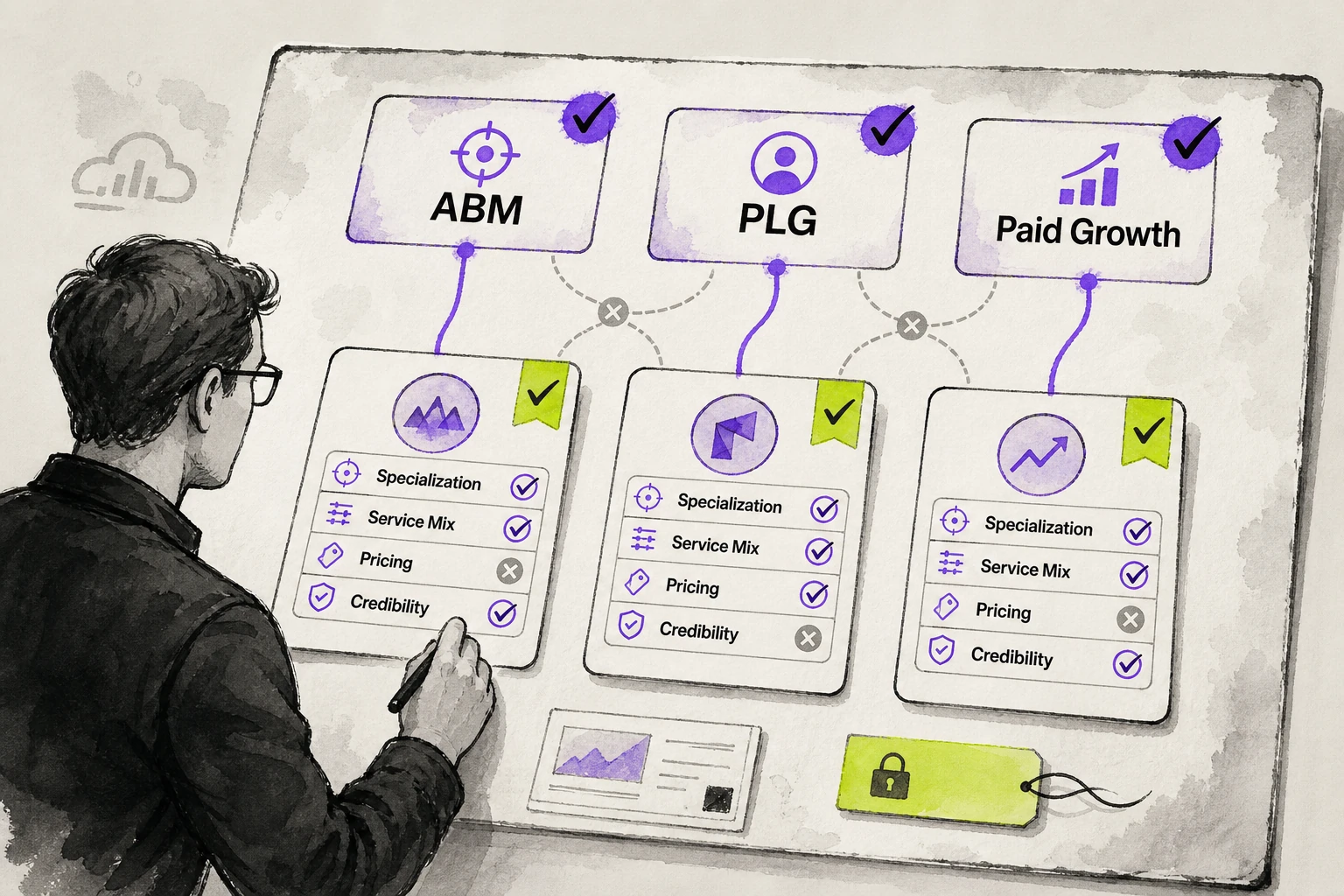
Full-service language blurs the buying decision. It tells you what an agency can list, not whether it understands the growth constraint that actually matters. Better evaluating agencies means starting with four harder tests.
- Test SaaS depth, not just channel fluency.
- Judge service-fit against the actual bottleneck.
- Read pricing as a signal about staffing and access.
- Favor repeated client patterns over polished positioning.
How Deep the SaaS Specialization Goes
SaaS specialization is not channel fluency. It is operating fluency in how SaaS companies grow, where revenue influence is created, and how a long sales cycle reshapes marketing promises inside SaaS businesses. Real SaaS expertise appears before the plan does.
- They ask how revenue is won, renewed, or expanded.
- They probe the sales cycle and demo-to-close friction.
- They separate lead volume from qualified pipeline and revenue influence.
Whether the Service Mix Fits Your Problem
A long service menu often hides a short diagnosis. Service-fit turns on the real bottleneck, not the longest offer list.
| If the problem looks like this | The better fit is usually | Why it matters |
|---|---|---|
| Traffic comes in, but qualified pipeline stays thin | Positioning, conversion, or funnel diagnosis first | More spend will not fix a weak path to pipeline |
| Named accounts matter more than broad lead flow | An account-focused program with tighter sales coordination | The job is progression, not volume |
| Meetings are the short-term constraint | A narrow lead-generation service with clear volume ownership | Focused delivery can beat a broad retainer |
| Product, paid, and lifecycle friction all affect growth | A growth-oriented scope across channels and handoffs | The bottleneck sits between functions |
What the Pricing Model Reveals Early
Pricing exposes the delivery model before the work begins. A low fee with broad promises often buys thin attention, while a higher fee can still misfit if it assumes marketing spend or internal support the buyer lacks.
- Flat pricing can signal a packaged model.
- Layered retainers can show where senior access is separated.
- If the plan assumes heavy marketing spend before diagnosis, activity is outrunning fit.
Which Client Pattern Signals Better Fit
Client history matters less as prestige than as repetition. Agencies usually fit some company shapes better than others: Lean SaaS teams that need one sharp motion, more-complex mid-market groups that need coordination, or larger organizations that can support broader orchestration. Pattern fit is the real signal.
- Look for recurring stage, size, and complexity patterns.
- Lean company repetition suggests comfort with lower bandwidth.
- Mid market repetition suggests comfort with more stakeholders and longer cycles.
Red Flags Before You Sign Anything
A polished pitch often asks for trust before it gives up control. Once fit is on the table, the harder job is to question vague proof, all-motion positioning, slippery process answers, and claims that sound universal before they sound measurable.
- Case studies that show activity but not commercial impact
- Positioning that claims strength across every motion
- Sales-call answers that blur process, reporting cadence, or operator access
- Claims that sound absolute before they sound testable
Case Studies That Say Little About Pipeline
Traffic charts and lead totals often perform confidence, not proof. A case study becomes thin when it shows lift at the top of the funnel but never explains the starting problem, the actual intervention, or whether the work helped connect marketing activity to revenue outcomes. That is the difference between vanity metrics and pipeline proof.
- The story starts with growth numbers but never states the commercial baseline.
- Lead volume appears, but measurable pipeline outcomes do not.
- Channel activity is described in detail, but sales impact stays abstract.
- The agency reports clicks, traffic, or form-fill gains as if those alone prove revenue outcomes.
- No explanation shows how the work was meant to connect marketing activity to pipeline creation.
Positioning That Promises Every Motion
An agency that claims equal command of ABM, demand generation, lead generation, product-led growth, paid acquisition, and automation may be selling range where depth should matter. Different motions require different operating judgment, different reporting logic, and different talent. Broad positioning is not disqualifying by itself, but it deserves more scrutiny when the pitch sounds interchangeable across every problem. Specialization creates friction. That friction is often where the real competence shows.
Sales Calls That Dodge Process or Access
Evasion usually appears before the contract does. When answers stay glossy around delivery, reporting, or who actually does the work, the problem is not just poor communication. It is weak ownership, which usually means weak accountability once control shifts to the agency.
- Strategy Owner Named: A specific post-sale owner is identified by role and responsibility, not just by senior title.
- Reporting Cadence Defined: The team states how often reporting is delivered and what the reader will actually see.
- Access to Senior Operators Confirmed: The buyer can tell whether senior operators are available or kept behind an account layer.
- Execution Ownership Explained: Campaign setup, data hygiene, and handoff logic each have a clear owner.
- Stall Response Described: The team can explain what happens in the first 60 days if performance stalls.
Credible Claims Versus Risky Claims
Claim quality matters because sales language often hides its own limits. Credible claims stay narrow, conditional, and tied to measurable outcomes. Risky claims sound bigger, cleaner, and less accountable than the work itself.
| Signal | Credible claims | Risky claims |
|---|---|---|
| Scope | Describes a specific motion, audience, or constraint | Claims broad success across nearly any situation |
| Conditions | States what must be true for the work to succeed | Skips prerequisites and presents success as automatic |
| Measurement | Ties performance to commercial outcomes or measurable outcomes | Relies on general uplift language without a clear business result |
| Tone | Uses precise, limited language | Sounds guarantee-like or universal |
| Buyer takeaway | Invites verification | Tries to end scrutiny |
Choose the Right Motion Before Comparing Agencies
Most agency searches fail because the buyer misnames the problem. The real decision is not which firm claims to do everything. It is whether the constraint is demand generation, lead generation, growth marketing, or a broken handoff inside the marketing team. Choose the motion first, because each one changes what good work, reporting, and fit look like.
- Start with the bottleneck, not the service menu.
- Separate account quality from meeting volume.
- Treat process leakage as different from weak acquisition.
- Rule out any motion solving for activity when the constraint is elsewhere.
Account Based Marketing for Named Accounts
ABM is a precision motion, not a louder version of broad-acquisition. Account based marketing fits when the problem is named-account penetration, deal quality, or weak sales marketing alignment in competitive markets where a small set of accounts matters more than raw lead flow. The work is narrower, slower, and more deliberate: tighter targeting, sharper messaging, and stronger sales alignment around who matters and why.
- Choose this route when the target list is already clear or can be defined tightly.
- Use it when sales marketing alignment is the constraint, not top-of-funnel volume alone.
- Expect better fit for high-value deals where account based marketing can focus attention on penetration and progression, not just response.
- Avoid it when the real mandate is simply to create more meetings across a wide market.
Demand Generation for Pipeline Creation
The problem here is not lead capture. It is thin market interest, which means more inbound marketing alone will not create pipeline. Real demand generation works when a demand generation strategy links brand strategy, creative strategy, and marketing efforts to buyer intent so demand creation produces qualified pipeline rather than empty form fills. Done well, demand generation turns attention into a predictable growth engine and supports revenue growth. Done badly, it just gives predictable growth a nicer-sounding label.
Lead Generation for Meeting Volume
Lead generation is the narrowest route in this set, and that is its value. Use lead generation when the offer is clear, the follow-up motion already works, and the sales team mainly needs more conversations. This is a volume system for customer generation, not a substitute for positioning, messaging, or market education, especially in long sales cycles where weak qualification can flood the team with noise instead of opportunity.
- Choose it when meeting volume is the true bottleneck.
- Keep it narrow when the company already knows who converts and why.
- Be cautious if poor follow-up, weak messaging, or unclear ICP is depressing results.
- Do not ask lead generation to solve a demand problem it cannot solve.
Growth Marketing Across Product and Paid
Growth marketing is often sold as performance marketing with a broader title. That misses the point. Growth marketing fits when sustainable growth depends on learning across paid media, product experience, conversion strategy, and retention rather than on paid campaigns alone.
Consider the pattern: paid acquisition brings new users in, web design shapes activation, paid advertising tests positioning, customer success affects expansion, and net revenue retention determines whether the whole system actually compounds. In that model, paid channels are only one input. The real job is to connect customer acquisition to measurable growth across the funnel, then use those signals to Accelerate growth with more judgment and less channel vanity.
This route makes sense when the company needs cross-functional learning, not just media buying. If the ask is only to run paid campaigns, growth marketing is too broad a label. If product, lifecycle, and performance data all need to inform one another, it is the right category.
Marketing Automation for Handoffs and Nurture
More campaigns cannot fix a broken funnel. Marketing automation is the right route when the pipeline is leaking between capture and conversion, and the real failure sits in marketing operations, revenue operations, nurture logic, scoring, routing, or revenue reporting. This is less about creating demand than about restoring control over how demand moves.
- Choose marketing automation when leads stall after form fill or demo request.
- Use it when handoffs between marketing and sales are inconsistent or slow.
- Prioritize it when nurture paths, scoring rules, or routing logic create avoidable loss.
- Expect the goal to be cleaner execution and clearer revenue reporting, not more top-of-funnel activity by itself.
Rule out Mismatch by Stage and Budget
Stage and Budget are not prestige signals. They are elimination tools that show whether a team can use a given agency model well.
- Seed: focused help around one constraint usually fits better than a broad retainer.
- Growth: channel or motion depth with measurable accountability matters more than a wide service menu.
- Scale: orchestration across channels and stakeholders matters more than another isolated specialist.
Seed Stage Needs Specialist Help
Early teams usually have one binding constraint, not a full marketing system to manage. Before product market fit is stable, messaging, channels, and handoffs keep moving, so seed-stage fit usually favors specialist help over a broad retainer. Many early stage SaaS companies buy coverage they cannot direct, measure, or absorb.
For SaaS companies at this point, narrower support is often safer because it concentrates scarce budget and attention on the bottleneck that matters now. The hidden cost of a full-service promise is managerial overhead.
Growth Stage Needs Channel Depth
Growth changes the hiring test. Once the motion is clearer, the question is less about broad coverage and more about real depth in the channel or motion that drives pipeline. The right fit helps growth stage companies push one proven engine further.
- Look for depth in the exact motion the team needs, whether that is paid acquisition, demand creation, or a tighter handoff model for growth stage SaaS companies.
- Prefer a partner with clear operating ownership, because high growth SaaS companies usually need measurable execution, not broad strategy language alone.
- Favor agencies that improve one expansion path at a time. For SaaS companies, scale acquisition usually breaks when teams add too many channels before the core engine is reliable.
- Treat broad capability as secondary. For most growth stage companies, channel depth matters more than a longer service menu.
Scale-Stage Needs Broader Orchestration
At scale, the bottleneck is often coordination, not isolated execution. A larger team may already have capable specialists but still lack a partner that can align reporting, priorities, and stakeholder decisions across the system. That is when scale-stage orchestration matters more than another narrow-executor.
Scaled teams often underbuy here. They hire a specialist for a coordination-heavy problem and get local wins without organizational clarity.
Top B2B SaaS Marketing Agencies Reviewed Honestly
Most B2B SaaS marketing agencies sell a range before fit. This comparison table treats public positioning as a clue, not a ranking, and forces five B2B SaaS options through the same test: which partner actually fits the motion, model, and readiness already defined above for B2B SaaS companies and other SaaS companies? That is how B2B SaaS marketing stays a judgment instead of a prestige contest across SaaS marketing agencies and SaaS marketing claims.
| Agency | Current positioning cue | Services emphasized | Likely fit | Likely non-fit | Main caution area |
|---|---|---|---|---|---|
| Directive Consulting | B2B growth partner focused on qualified pipeline over MQLs | Paid media, content, creative, programmatic, RevOps, communications | Teams wanting cross-channel pipeline accountability | Buyers wanting a narrow specialist or light one-channel help | Check how much depends on broader program scope |
| Refine Labs | Demand generation partner pushing a shift from traditional lead generation | Demand creation and capture, paid search and social, pipeline and revenue measurement, account-focused programs | B2B SaaS teams ready to change measurement and GTM thinking | MQL-led teams or cheap fulfillment buyers | Probe change assumptions, reporting logic, and execution depth |
| Kalungi | GTM-as-a-Service model with Associate CMO leadership | CMO-as-a-Service, ABM, RevOps and HubSpot, paid media, content and SEO, brand and web support | SaaS teams needing leadership plus multi-function execution | Mature in-house teams needing only one specialist lane | Clarify ownership, customization, and real channel depth |
| Single Grain | Full-service digital growth agency with SaaS acquisition positioning | Paid advertising, SEO, content, CRO, email and social, demand generation | Teams with strategy set that want scalable acquisition execution | Buyers needing fractional GTM leadership or deeper operating guidance | Confirm team assignment and how revenue quality is measured |
| Accelerate Agency | Closed brand redirecting to Evolv, a current search-first alternative | Successor emphasis on SaaS SEO, technical SEO, and search visibility | Search-led buyers comparing current SEO-focused options | Anyone expecting an active standalone Accelerate engagement | Make the closure and brand transition explicit |
Directive Consulting
Prestige obscures more than it clarifies. Directive Consulting looks strongest when a team wants cross-channel accountability tied to qualified pipeline, and weaker when the real need is only a narrow lane. The question is not whether Directive Consulting sounds impressive. It is what kind of engagement it is actually built to run well.
Who Directive Consulting Fits Best and Where It Excels
Directive Consulting fits best when the problem is not one isolated channel but performance marketing across connected functions. A team that needs paid media, reporting discipline, creative support, and clearer pipeline accountability may get more from this model than a company shopping for one tactician. That is the appeal of a performance marketing agency with broader scope: performance marketing can be judged against revenue language rather than lead volume alone.
- Best fit for B2B SaaS teams that want qualified-pipeline accountability rather than MQL-centered reporting.
- Strength appears to come from broad channel coverage, not one isolated specialty.
- Useful when leadership wants execution, measurement, and RevOps-related questions tied together more tightly.
- More attractive when the company can absorb a fuller growth program instead of a narrow campaign handoff.
Who Directive Consulting Is Not the Right Fit For
Broad scope can disguise a basic mismatch. Directive Consulting looks less convincing for buyers who want a lightweight generalist, a narrow specialist, or a small engagement that still expects the force of a multi-channel model. The risk is not capability. It is assuming a large-program promise transfers cleanly to a smaller operating need.
- Rule it out if the immediate need is one channel and little else.
- Be cautious if leadership wants minimal process change or limited reporting complexity.
- It is a weaker fit for teams that want inexpensive fulfillment rather than broader performance accountability.
- It is less attractive when the business cannot support cross-functional coordination after the sale.
Claims and Sales Signals to Scrutinize
- Ask which channels are truly in scope for the proposed engagement, not just listed in the pitch.
- Clarify who owns RevOps and reporting design once the work begins.
- Verify what level of senior operator access continues after the sales process.
- Test whether qualified-pipeline accountability depends on a broader program than the company actually wants to buy.
Refine Labs
Refine Labs sells a thesis, not just a menu. It looks strongest when a team wants demand generation tied to pipeline and revenue and is willing to change how success is measured, but that same thesis creates friction for companies still organized around MQL volume. The real test is readiness for a different operating logic.
Best Fit and Core Strengths
Refine Labs makes the clearest case for teams that do not just want more activity. They want a demand generation model that reorders measurement around pipeline and revenue, and they are willing to let that decision reshape marketing and sales behavior. That can be powerful for a mid-market or enterprise B2B SaaS team, but only if leadership wants a demand generation agency with a strong thesis rather than a quiet execution vendor.
- Strong fit for teams ready to move away from legacy lead-generation logic.
- Core appeal comes from demand creation and demand capture framed against pipeline and revenue outcomes.
- Useful for account-focused programs where leadership wants clearer GTM judgment, not just channel output.
- More compelling when the internal team is ready to adopt a stronger point of view about measurement.
Not Right for Every Team
Strategic confidence is not the same as universal fit. Refine becomes harder to justify when the company still wants MQL volume as the main proof of value, needs cheap tactical fulfillment, or lacks the internal alignment to support a shift in how marketing and sales are judged. In that setting, the agency's strength can turn into governance friction.
- A weak fit for teams still committed to MQL-led reporting.
- Less suitable for buyers who want execution only and no strategic pressure on the GTM model.
- Riskier when sales and leadership are not aligned on what replaces legacy lead metrics.
- Harder to absorb when the organization cannot support the operational change implied by the pitch.
What to Watch in the Pitch
- Ask what changes the agency expects from sales leadership, not just from marketing.
- Require a clear explanation of what reporting replaces MQL logic and how pipeline or revenue will be read.
- Separate advisory work from execution work so the scope is legible before signing.
- Test how much success depends on internal alignment that the agency does not control.
- Carry that same comparison lens into the remaining agency reviews.
Kalungi
- Best Fit: a broader orchestration-support option for SaaS teams that need leadership plus execution across several marketing functions.
- Non-Fit: buyers shopping for one precise specialist or one narrow channel fix.
- What Changes the Decision: the model is more useful for thin internal teams than for teams that already know the exact lane they need.
Best Fit and Core Strengths
Kalungi fits teams that lack coverage across GTM functions and need structure before channel intensity. Its public positioning centers on an outsourced department model with Associate CMO support, giving a team senior marketing leadership without forcing every role in-house. That breadth is the draw. It can also shift control through process and handoffs.
- Best for teams that need leadership and execution at the same time, especially when internal marketing coverage is thin.
- Strength lies in broader orchestration support across ABM, RevOps, paid media, content, branding, and web work rather than in one isolated lane.
- The appeal is one operating model for full funnel SaaS marketing, which can simplify coordination for a SaaS marketing team that is still forming.
Not Right for Every Team
A broad package can solve a coverage problem, but it can also create an ownership problem. Kalungi is weaker when the buyer already knows the exact gap and only needs one sharp capability, because a wider operating model can add process and coordination the company does not need.
- Rule it out if the need is one precise function, such as a single paid-media lane or a tightly scoped content program.
- Be careful if the in-house team is already mature and only wants outside execution support, not a broader operating structure.
- It may be heavy for teams that cannot absorb new handoffs, shared ownership, or senior-layer guidance across functions.
What to Watch in the Pitch
- Ask what the Associate CMO personally owns versus what is delegated to the rest of the team.
- Clarify which functions are standardized inside the package and which are customized to the account.
- Press on Handoffs: who owns strategy, execution, approvals, and reporting once the engagement starts.
- Separate included breadth from real depth by asking where the strongest channel expertise actually sits.
Single Grain
- Best Fit: an execution-led acquisition partner for teams whose strategy is mostly set.
- Non-Fit: buyers looking for a universal SaaS GTM authority or a full strategic reset.
- What Changes the Decision: its public positioning points to scalable growth across paid, SEO, content, and CRO, so the real question is throughput and funnel execution.
Best Fit and Core Strengths
Single Grain fits buyers who already know the motion and need more disciplined acquisition output, not a reinvention of the whole GTM model. Its appeal is operational range across paid advertising, SEO, content, CRO, and related digital execution. That combination can help when growth depends on scaling channels that are already chosen. The tradeoff is structural: a broad acquisition menu can look like strategic depth even when the deeper need is leadership, positioning, or cross-functional redesign.
- Best for teams with strategy mostly in place, that want scalable execution across paid and organic acquisition.
- Useful when the growth problem is channel output, testing pace, and conversion improvement rather than GTM re-architecture.
- The paid, SEO, content, and CRO mix gives one team a wider execution surface than a single-lane specialist can offer.
Not Right for Every Team
Execution strength is not the same as operating guidance. Single Grain is a poorer fit when the company still needs leadership-level decisions about positioning, sales and marketing alignment, or a broader SaaS-growth system that reaches beyond acquisition channels.
- Rule it out if the main gap is GTM redesign rather than channel execution.
- Be cautious if the team needs fractional leadership or deep cross-functional orchestration across product, sales, and marketing.
- It is a weaker fit when the buyer wants proof of revenue quality ownership beyond clicks, leads, or campaign activity.
What to Watch in the Pitch
- Ask who owns funnel quality after the click or lead, not just media delivery.
- Confirm how SaaS-specific the assigned team is rather than assuming the service menu guarantees depth.
- Press on how performance is judged and whether revenue quality is measured beyond top-of-funnel volume.
- Ask what share of the growth thesis depends on paid media versus SEO, content, and CRO working together.
Accelerate Agency
- Status: Accelerate Agency is not a current standalone option.
- Practical Comparison: The official domain redirects to Evolv, but that present-day alternative should be judged separately.
- What Not to Do: Do not inherit old assumptions from a defunct agency when evaluating a current search-led option.
Best Fit and Core Strengths
The useful comparison here is historical and problem-based, not a live endorsement. Buyers drawn to Accelerate were typically looking for a content marketing agency built around a content-first, search-led growth model, where content creation and editorial quality content were central to the pitch. That still helps classify the offering. It does not restore the agency as an active recommendation.
- The old appeal was closer to a content marketing agency than to a full GTM partner.
- The historical fit was search-led growth with a content-first model.
- That still helps readers classify what they were shopping for before they compare a current alternative.
Not Right for Every Team
A content-first model was never a cure-all, and closure makes that limit sharper. This path was a mismatch for buyers who needed a still-operating partner with breadth across paid media, ABM, RevOps, or broader marketing operations.
- Rule it out immediately if the requirement is an active standalone Accelerate engagement.
- It was also the wrong shape for buyers needing full-funnel paid-media, ABM, or operations support instead of search-led growth.
- Teams wanting one partner to own broader orchestration should compare an active alternative, not a closed brand.
What to Watch in the Pitch
- Make the closure and redirect explicit before any comparison starts.
- Do not carry over historical brand claims as if they describe a current agency offer.
- If evaluating Evolv, judge it on its own present positioning around SaaS SEO and search visibility.
- Press on attribution so traffic or content narratives are tied to a real business outcome, not nostalgia.
Build a Defensible Shortlist and Outreach Plan
The last mistake is not choosing the wrong agency. It is carrying too many different bets into outreach and asking the sales call to sort them. A defensible shortlist starts narrower: keep only firms solving the same core problem, then test fit against team, budget, and buying constraints.
- Step 1: Cut the list by motion, stage, and budget before any more meetings.
- Step 2: Keep only the options that match the same immediate growth problem.
- Step 3: Pressure test the final few on proof, process, access, and assumptions before outreach begins.
That sequence protects judgment and turns outreach into a focused buying process.
Cut the List by Motion Stage and Budget
Shortlists get weak when they mix unlike motions. Cut for fit, not brand surface area.
- Match each agency to one primary motion.
- Check stage fit against the current operating reality.
- Remove options that require a budget the company cannot sustain through one testing cycle.
- Keep only service mixes that address the real bottleneck.
- Keep agencies whose approach supports the company's growth objectives.
If two agencies would be judged on different success logic, they should not survive the same cut.
Pressure Test the Final Few Options
The final call should test how an agency thinks under scrutiny, not how smoothly it presents.
- Probe Proof Quality: What outcomes were measured, and under what conditions?
- Test Process Clarity: How does strategy turn into execution, reporting, and course correction?
- Verify Operator Access: Are the people in the pitch the people doing the work, and can revenue leaders reach them when conditions change?
- Surface assumptions about budget, sales capacity, conversion baseline, product readiness, and internal support.
- Listen for reporting logic that stays clear if early results are mixed.
Choose the agency whose answers stay legible when the pitch gets specific, then send an outreach plan built around that pressure test.