
.svg)
.svg)
.svg)
What makes a campaign truly integrated?
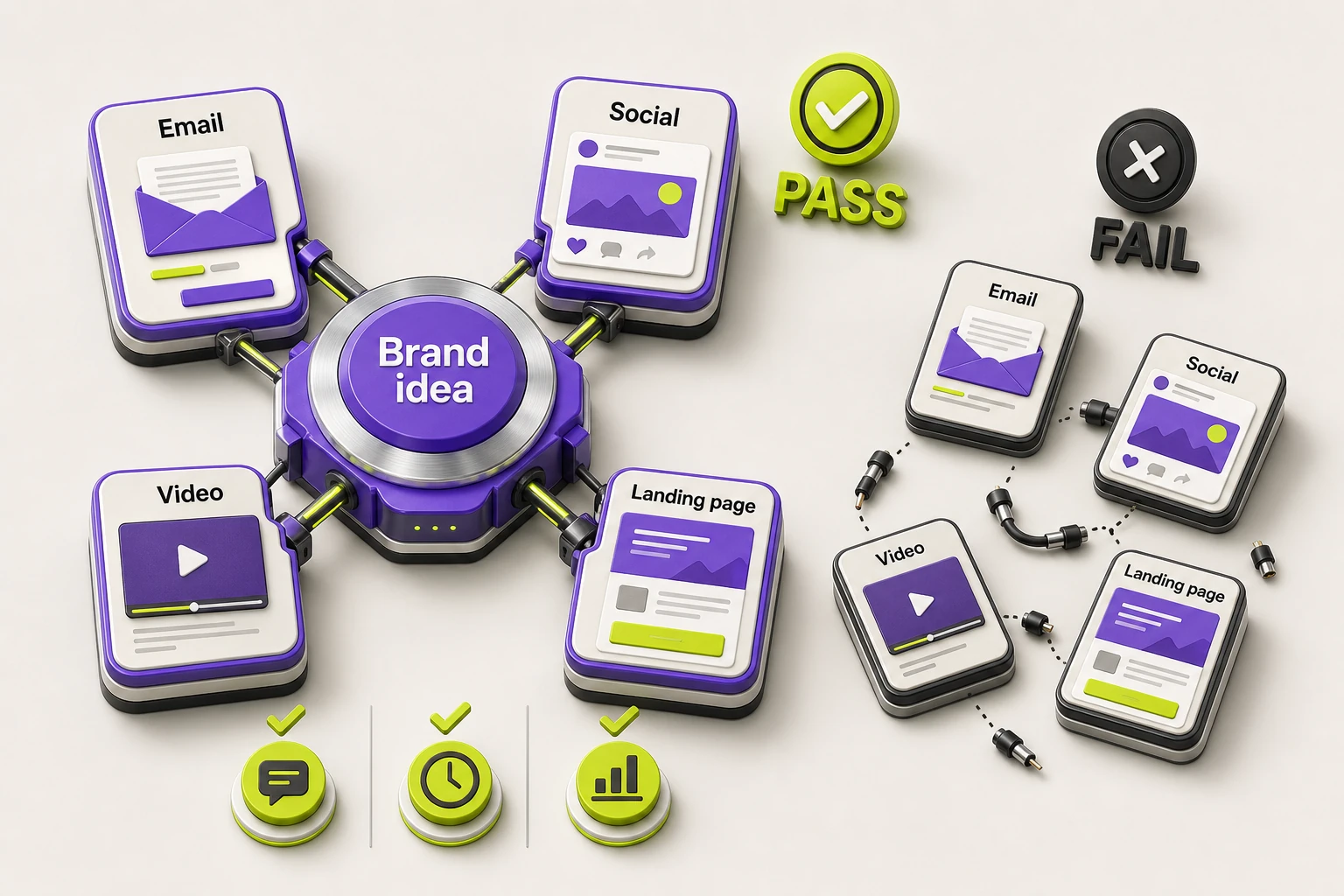
A campaign is truly integrated when it runs on one governing message, one shared objective, and clear channel roles that reinforce the same decision logic. It should show message unity, role alignment, data-led orchestration, and system-level coordination, so removing a key channel makes the campaign feel weaker.
What an Integrated Campaign Is, and What Makes It More Than Multi-Channel Marketing
Many campaigns appear in several places at once, but channel count is the wrong starting test. An integrated campaign ties integrated marketing to one governing message, one shared objective, and clear channel roles, so each touchpoint reinforces the same decision logic instead of operating as separate promotions. In integrated marketing communications, the creative may shift by format, audience moment, or platform behavior, but the campaign still works as one system. That is the practical way to define integrated marketing.
- An integrated campaign keeps one core idea intact while adapting execution by channel.
- A marketing team assigns each touchpoint a job, such as awareness, proof, participation, or conversion, rather than posting the same asset everywhere.
- Multi channel marketing can still be fragmented when channels run in parallel, chase different goals, or use inconsistent messages.
- If one channel disappears and nothing else about the campaign changes, the work was likely distributed across channels, not truly integrated.
The Four Markers of an Integrated Approach Across Multiple Channels
The standard is coordination. A real integrated approach across multiple channels does more than keep a brand visible on multiple channels. It uses a shared operating logic that connects message, timing, audience intent, and execution. An effective integrated marketing strategy becomes easier to judge when the four markers are explicit as key elements.
- Message Unity: the campaign carries one recognisable idea without repeating the same copy everywhere.
- Role Alignment: timing, tone, and channel roles support one brand identity instead of competing for attention.
- Data-Led Orchestration: customer signals and campaign goals shape where each message appears, when it appears, and what it needs to do.
- System-Level Coordination: the integrated marketing approach should feel weaker if a key channel is removed, because the parts were designed to work together.
A Consistent Brand Message Shows up Without Copy-Paste Repetition
Consistency is a recognition test, not a duplication test. A consistent brand message gives the audience the same underlying idea wherever it appears, but the expression should change across different platforms. Headlines, visuals, calls to action, and proof points can all shift to fit context while the unified message stays intact. The practical check is simple: if the audience can still name the same promise, tone, or point of view after seeing different executions, the campaign is coordinating rather than merely repeating. When each touchpoint changes so much that the campaign loses that thread, the system has lost control of the brand message. When marketing messages look identical everywhere, the campaign may be repeating assets rather than coordinating them. The stronger signal is consistent messaging that lets people recognize the same brand message in different forms.
Timing, Tone, and Channel Roles Support One Brand Identity
A campaign stops feeling integrated when every channel tries to do the same job at the same moment. Strong coordination gives various channels distinct responsibilities while preserving one brand identity. That means launch timing lines up, tone remains recognisable, and each placement helps move the audience forward instead of repeating the last touch.
- One channel may introduce the idea while other channels deepen proof or prompt action.
- Different channels can vary in format and energy, but the voice should still feel connected.
- Other channels should respond to campaign timing, not publish on isolated schedules.
- Across various channels, role clarity matters more than equal activity.
Customer Data and Campaign Goals Shape the Orchestration
Integration becomes guesswork when channel choices are driven by habit instead of evidence. Customer data should help a marketing team decide which moments matter, which segments need different pressure, and how the target audience moves from first exposure to action. That includes target audience's demographics when relevant, but the stronger control signal is behavior across the entire customer journey. Campaign goals turn that view into operating logic: one sequence may build awareness, another may improve customer loyalty, and another may push conversion. The point is not a seamless customer journey as a slogan. It is using customer data and campaign goals to assign work to channels that matches the target audience and keeps the campaign coordinated as one system.
The Test Is Coordination, Not Just Presence on Multiple Channels
This is the real pass-fail test. A campaign is not integrated because it appears on different marketing channels or because a brand uses various marketing channels at once. It qualifies when the marketing channels depend on shared logic, reinforce one another, and make the campaign weaker when that coordination breaks.
- Pass: each channel adds a distinct function to one campaign objective.
- Stretch: the brand shows up on multiple channels, but the connections among them are thin or inconsistent.
- Miss: different marketing channels operate as separate efforts with no clear coordination standard.
That is the rubric the next section applies to real campaigns.
Integrated Marketing Examples That Pass, Stretch, or Miss the Test
The rubric matters when it imposes a hard-operating test. These integrated marketing campaigns are locked to one named edition or launch window, then checked for message unity, channel roles, timing, and attributable outcomes. That standard separates successful integrated marketing from channel accumulation and turns real world examples into usable evidence. For readers mastering integrated marketing campaigns, coordination is the standard. Without it, even successful integrated marketing campaigns are only busy marketing campaigns.
| Brand example | Year or scope | Verified channels or touchpoints | Judgment | Best outcome signal |
|---|---|---|---|---|
| Nike Dream Crazy | 2018 | Hero film, social distribution, OOH extensions | Pass | Third-party ecommerce signal: online sales grew 31% from Sunday through Tuesday post-launch |
| Spotify Wrapped | 2023 edition | In-app personalized experience, Spotify.com/Wrapped hub, social share cards, Artist Messages | Pass | 225M+ MAUs engaged; engagement grew more than 40% YoY across 170 markets |
| Coca-Cola Share a Coke | U.S. 2014 core example | Personalized packaging, TV, cinema, digital, OOH, #ShareaCoke social, ShareACoke.com, 500+ stop tour | Pass | Coca-Cola cited +10% sparkling growth in China tied to the June 2014 activation; North America brand Coca-Cola volume +1% in Q2 2014 |
| Apple iPhone 6 launch | 2014 | Launch announcement, website product pages, pre-order communications, retail rollout, TV ads | Pass | 4M+ pre-orders in first 24 hours; 10M+ sold in first weekend |
| Generic multi-channel failure case | N/A | Many channels with weak connective logic | Miss | No single metric proves integrated marketing when roles and timing are unclear |
How to Judge an Integrated Marketing Example Against the Four Markers
A strong integrated marketing example holds up under a short operational test. The campaign's success should come from coordination, not from fame, budget, or channel count alone.
A strong integrated marketing example holds up under a short operational test.
- Confirm that one clearly named campaign or edition is being judged.
- Check whether the same core idea is recognizable across every touchpoint.
- Look for a distinct role for each channel rather than duplicate presence.
- Ask whether timing and sequence made channels reinforce one another.
- Use outcomes tied to that specific campaign version, not to the whole brand.
- Remove any touchpoint that would not change the logic; if nothing changes, it was coverage, not integration.
Nike: One Brand Idea, Coordinated Across Multiple Channels
Nike's "Dream Crazy" in 2018 passes because one idea governed the system. As an integrated marketing case, it did not scatter a marketing strategy across multiple channels and hope the pieces aligned. The film carried the meaning, and the supporting touchpoints extended that meaning across multiple channels without changing the campaign's center.
Which Channels Appeared in the Campaign
The verified Nike mix is intentionally narrow. Direct marketing claims are not the point here; the evidence supports a film-led system with distribution and extension touchpoints.
- Hero film as the central campaign asset
- Social media distribution that carried the same campaign idea into social media channels
- OOH extensions that repeated the same thematic direction in digital marketing and public display contexts
- No verified evidence here for a broader channel list such as email, retail activation, or separate TV ads
How the Channels Work Together
The coordination logic is simple, which is why the example holds. Dream Crazy works because the hero film defines the campaign, while social media and OOH act as distribution and reinforcement layers rather than separate creative directions.
In practice, the film carries the emotional and thematic load. Social media extends reach and discussion, while OOH preserves the same message in a public format that keeps the campaign visible after the first viewing. That structure supports customer engagement because each touchpoint does a different job inside one campaign system instead of competing for attention with a new message.
Results and Outcomes
The outcome signal is directional rather than definitive. Marketing Dive, citing Edison Trends, reported that Nike online sales rose 31% from Sunday through Tuesday after launch, which supports the judgment that the campaign translated attention into action without proving sole causation.
- Use the 31% figure as a post-launch sales signal, not as conclusive proof of full campaign causality.
- Treat the result as evidence that coordinated touchpoints can help convert attention into customer engagement.
- The Practical Lesson Is Structural: the campaign produced one recognizable system, and the market response suggests that system worked.
Spotify Wrapped: Personalization Turns Customer Data Into Brand Recognition
Spotify Wrapped 2023 stands out for a different reason. Here, customer data is the coordinating engine: private listening summaries become branded outputs that users want to share, so brand recognition grows from the same underlying system rather than from disconnected promotion. That makes the campaign a stronger integrated marketing example than a standard year-end recap.
Channels Used
Wrapped combines owned delivery with public amplification. The channel mix matters because Spotify controls the first experience, then lets social media marketing expand it outward. The structure starts with a private listening summary inside Spotify-controlled surfaces, then pushes share-ready assets into social media and adjacent public touchpoints.
- In-app personalized Wrapped-experience
- Spotify.com/Wrapped browser hub
- Share cards and other outputs designed for social media
- Artist Messages with creator participation inside the same campaign frame
How the Channels Work Together
Spotify solves a coordination problem that many brands miss. It turns one-to-one-listening data into user generated content without losing the same Wrapped identity across every touchpoint.
The in-app experience is the private core. Spotify.com/Wrapped extends access in a browser, Artist Messages deepen the same campaign environment, and the share cards convert personal summaries into public distribution. Because the visual language and summary logic stay intact from private screen to public post, the channels do not fragment the idea. They operationalize it.
Results and Outcomes
Spotify's results are stronger because they are tied to the 2023 edition itself. The company reported that more than 225 million monthly active users engaged with the ninth annual Wrapped campaign; engagement grew more than 40% year over year across 170 markets; and Artist Messages generated nearly 725 million video views.
- 225M+ MAUs engaged, tying the campaign to large-scale website traffic and in-product participation.
- More than 40% YoY engagement growth across 170 markets, supporting the view that the system scaled internationally.
- Nearly 725M video views for Artist Messages, showing how owned assets and social media outputs reinforced social media engagement.
The evidence suggests that the same personalized asset moved cleanly from owned experience to public sharing.
Coca-Cola's Share a Coke: a Unified Brand Message With Channel-Specific Execution
Integration can start on the product itself. In the U.S., 2014 Share a Coke campaign, the brand message was simple enough to travel across packaging, media, and participation touchpoints without becoming generic.
- Setup: Personalized packaging turned the bottle into the campaign entry point and gave the audience one clear act to recognize: find a name and share it.
- Interaction Logic: Media, social, and on-the-ground touchpoints widened that same invitation rather than replacing it with a different idea.
- Outcomes: The campaign is best read through geography-specific signals, not one global claim, which is why the supporting results stay attached to China and North America separately.
Channels Used
The channel mix matters because this campaign linked personalized packaging with TV, cinema, digital, out of home advertising, #ShareACoke social, ShareACoke.com, and a nationwide tour; print ads and print advertising are not part of the verified set here.
- Personalized name packaging on bottles and cans
- Nine-week TV, cinema, digital, and out of home advertising support
- #ShareACoke social participation
- ShareACoke.com for personalization and campaign interaction
- A nationwide tour with more than 500 stops
How the Channels Work Together
The coordination logic is straightforward. Packaging triggers the action first by turning a standard product into something people want to search for, photograph, give away, or personalize for someone else.
From there, paid media and social do different jobs inside the same loop. TV, cinema, digital, and OOH broaden the invitation, while ShareACoke.com and #ShareACoke give people a place to continue the act publicly. That is why the campaign feels integrated rather than duplicated. Every touchpoint reinforces the same participation idea instead of introducing a separate one.
Results and Outcomes
The evidence is directionally useful, but it has to be read with geographic discipline. Coca-Cola tied a 10% increase in sparkling growth in China to the June 2014 Share a Coke activation, while North America brand Coca-Cola volume rose 1% in Q2 2014. Those figures support the case as a geography-specific campaign signal, not a single global-performance claim, even where broader commentary says the campaign successfully repositioned the product or helped increase brand awareness.
- China: Coca-Cola cited 10% sparkling growth tied to the June 2014 activation
- North America: brand Coca-Cola volume rose 1% in Q2 2014
- Interpretation: useful campaign signals, but geography and scope stay attached to each figure
Apple Product Launches: Tight Timing Keeps Every Channel Working as One Campaign
Some campaigns integrate through a sequence more than message variation. The 2014 iPhone 6 launch works because each touchpoint entered the market inside one launch window, so attention, explanation, pre-order demand, and retail conversion all reinforced the same campaign rather than splintering into separate pushes.
Channels Used
Apple used a compact but tightly sequenced channel set. The value was not channel volume. It was role clarity across owned, retail, and paid surfaces, including email marketing, digital advertising, TV commercials, and other paid advertising around the launch window.
- Launch announcement and newsroom reveal
- Website and product pages for detail and comparison
- Pre-order communications, including email marketing
- Retail rollout for hands-on access and purchase
- TV commercials and related paid advertising support
- Digital advertising that extended launch visibility
How the Channels Work Together
Timing is the integrating mechanism here. The brand launched the iPhone 6 through an ordered sequence that kept each channel from competing with the next.
- Step 1: The launch reveal concentrates attention and gives the market one official campaign moment.
- Step 2: Website and product pages add specs, visuals, and comparison detail once interest is active.
- Step 3: Pre-order communications convert that interest while the launch announcement is still driving demand.
- Step 4: TV ads widen reach during the same window, reinforcing the same product story rather than restarting it.
- Step 5: Retail rollout closes the loop by turning launch interest into in-store evaluation and purchase.
That sequence is what makes the campaign integrated. Each touchpoint prepares the next one, so the launch functions as a governed handoff from attention to detail to conversion.
Results and Outcomes
Apple's outcome signals match the launch window closely enough to support the integration judgment. They do not prove that every channel caused the result on its own, but they do show that the coordinated release converted demand quickly once the brand launched the campaign.
- More than 4 million pre-orders in the first 24 hours
- More than 10 million units sold in the first weekend
- Interpretation: the launch sequence kept attention and conversion inside one tightly managed campaign window
How Multi-Channel Campaigns Fail the Criteria for a True Integrated Campaign
Channel count is not the standard. A campaign fails the integrated campaign test when coordination breaks, even if it appears everywhere at once.
A campaign fails the integrated campaign test when coordination breaks, even if it appears everywhere at once.
That failure usually looks broader than it is. Teams add more placements, more assets, and more launch activity, but the audience receives a loose collection of executions rather than a cohesive and impactful experience. The immediate symptom is inconsistency. The deeper issue is governance. No single decision structure is controlling message unity, timing discipline, and channel roles across the campaign.
The practical test is whether each touchpoint changes what the next one can do. In a real integrated campaign, packaging can trigger search, paid media can widen the same invitation, and social can turn response into visible participation. When that operating chain is missing, more channels add visibility without adding compounding effect.
- No Exact Campaign Instance: if the team cannot name one version, edition, or launch window, the evaluation is already too vague.
- Message Drift: the core idea changes by channel, so the audience sees related assets instead of one integrated campaign.
- Role Duplication: multiple channels do the same job, which creates coverage but not compounding effect.
- Timing Drift: launches happen on different clocks, so one touchpoint no longer strengthens the next.
- Weak Evidence Discipline: outcomes are pulled from broad brand performance instead of the specific campaign under review.
- Folklore Metrics: widely repeated numbers circulate without clear sourcing, which makes the integration claim harder to trust.
Each of those failures breaks campaign logic in a different place. Vague campaign boundaries make attribution unstable. Message drift breaks recognition. Role duplication wastes distribution on repeated tasks. Timing drift prevents one touchpoint from handing demand to the next. Weak evidence discipline then hides the coordination problem behind numbers that belong to the broader brand, not the campaign instance itself.
The recurring mistake is to treat distribution breadth as proof. Integration depends on whether each touchpoint changes the performance of the others inside one controlled system. If removing a channel would not alter campaign logic, that channel is probably just coverage. Fragmentation is rarely a creative mystery. It is a coordination failure.
Where Messaging, Timing, and Channel Roles Break Down Across Campaigns
Fragmentation usually starts before launch. The visible problem is difficulty juggling multiple channels. The structural problem is that no shared operating logic is telling those multiple channels what job each one serves, when it should appear, and what signal should pass to the next touchpoint.
Run the diagnosis in order. Start with the message, then check timing, then check role clarity, and only then ask whether the evidence belongs to the campaign instance under review. That sequence matters because later failures often begin with earlier ones.
- First, check message stability. If the message changes by channel, treat it as a messaging breakdown. Then stop treating the work as integrated, because the campaign no longer has one stable promise to carry forward.
- Next, check timing discipline. If launches happen on separate clocks, treat it as a timing breakdown. Then test whether one touchpoint still prepares the next; if it does not, the sequence has already fragmented.
- Then, check role clarity. If several channels do the same job, treat it as a role breakdown. Then ask what unique operating function each touchpoint adds, because repetition is replacing orchestration.
- Finally, check attribution. If the numbers belong to the brand rather than the campaign instance, treat it as an evidence breakdown. Then narrow the claim, because broad brand performance cannot prove campaign coordination.
These breakdowns tend to travel together. Once message ownership is loose, timing slips. Once timing slips, channel roles blur. Once roles blur, teams start proving success with broad brand metrics because the campaign no longer has a clean operating boundary.
That is why fragmentation is usually a planning and governance problem rather than a purely creative problem. The assets may look polished, but the system behind them is no longer controlling sequence, role assignment, or evidence standards.
That is the diagnostic shift the next section needs. Before a team calls a campaign integrated, it should test whether the message, timing, roles, and evidence still hold together under one governing standard.
How to Judge Your Own Campaign Before You Call It Integrated
Most campaigns look coordinated from the outside. The real question is whether the parts operate as one system or simply appear in many places at once. Use the same four markers from the earlier examples as a pre-launch test for your integrated marketing plan: one governing message, distinct channel roles, aligned execution, and measurable objectives coherence.
- Check whether every piece of integrated marketing supports the same central idea.
- Confirm that each channel has a clear job inside the broader integrated marketing strategy.
- Review whether timing, tone, and integrated marketing efforts still reinforce one another.
- Decide whether the full marketing plan should pass, be revised, or stop before launch.
Shared Markers of a Strong Integrated Campaign Before You Plan Your Own
A strong integrated campaign is built on coordination rules, not channel volume. Before planning begins, the team should be able to state the standards that will govern every decision. That strategic approach keeps marketing efforts from drifting into disconnected activity.
- Message Unity: The integrated campaign expresses one core idea without turning every channel into copy-paste repetition.
- Defined Channel Roles: Each channel supports the integrated campaign in a different way instead of repeating the same task.
- Execution Alignment: Timing, tone, and sequencing reinforce one another rather than competing for attention.
- Objective Coherence: Every activity supports the same business aim, so the campaign can be judged as one coordinated effort.
Start With the Message You Want Every Channel to Reinforce
Message drift usually starts before execution. If the team cannot name the governing message in one clear sentence, no integrated marketing communications strategy will hold once channels begin adapting it. The message has to stay stable enough to unify the campaign and flexible enough to fit the marketing plan across formats.
- Write the governing message as one sentence that expresses the campaign's central promise or point of view.
- Test whether that sentence can appear across integrated marketing communications without losing meaning when the format changes.
- Separate the message from the execution so headlines, visuals, email copy, and social posts can reinforce the same idea in different ways.
- Remove any channel-specific line that changes the promise, target, or basic intent of the campaign.
- Pause if different teams describe the campaign differently. That usually means the integrated marketing foundation is weak before launch.
Analyze Customer Data Before Assigning Channel Roles
Channel roles should follow evidence, not habit. When teams analyze customer data first, they can match each channel to a real point in the customer journey instead of forcing every channel to do everything. That is where orchestration becomes a planning decision rather than a distribution reflex.
- Analyze customer data to see where attention starts, where consideration deepens, and where action tends to happen across the sales funnel.
- Use customer journey mapping to identify which touchpoints introduce the message, which ones explain it, and which ones move the audience toward response.
- Conduct market research if the team is relying on assumptions about audience behavior rather than current evidence.
- Assign one primary job to each channel based on customer data, such as awareness, explanation, proof, or conversion support.
- Review the map again after analyzing data. If several channels have the same role with no clear reason, the campaign likely needs a better channel-role assignment.
Check Whether Timing, Tone, and Campaign Goals Still Line Up
Coordination often breaks late, after the message and channel map already look solid. A final alignment check keeps strong planning on track during execution. The purpose is simple: verify that campaign goals still govern what each channel is doing, when it appears, and how it sounds.
- Timing: confirm that launch dates, follow-up emails, paid placements, and social media activity support one sequence rather than colliding.
- Tone: review whether the voice stays recognizable across formats even when the copy length and creative treatment change.
- Goals: check that every asset serves the same campaign goals instead of slipping into unrelated brand or sales objectives.
- Measurement: make sure key performance indicators and analytics tools reflect the full campaign, not isolated channel wins.
- Review Layer: compare reporting from social media analytics with other channels so the team sees whether coordination is actually holding.
Test Whether the Campaign Is Truly Integrated Before Launch
The final decision should be blunt. A campaign either functions as one coordinated system, needs revision, or should stop carrying the label until the gaps are fixed. That is the practical value of a pre-launch test for integrated marketing communications campaign quality.
- Pass: use this result only when the campaign has one governing message, distinct channel roles, aligned timing and aligned tone, and shared objectives across integrated marketing activity.
- Revise: choose this when the campaign idea is sound but one part of the integrated marketing communications setup still conflicts with the others.
- Stop: use this when the channels are present but uncoordinated, the message changes by platform, or the objectives cannot be judged together.
- Labeling Rule: if the campaign fails any core marker before launch, it may still be multi-channel, but it is not yet integrated marketing.
- Decision Standard: call a campaign integrated only when coordination is designed into the system before the first asset goes live.