
.svg)
.svg)
.svg)
How to Choose Product Launch Ideas by Stage and Product Fit
A long list of ideas is not the hard part. The real product launch decision is choosing what fits this launch, in this sequence, with these constraints. A useful launch strategy starts with two filters: match each idea to the right launch stage, then narrow by audience readiness, budget, and channel reach. That turns a brainstorm into a shortlist for a more successful launch.
- If the goal is attention before the release, start with pre-launch options.
- If the goal is action on the release itself, focus on launch-day options.
- If the goal is retention, referrals, or a second wave of visibility, move to post-launch options.
- Then keep only the ideas that fit your audience warmth, budget, and channel reach.
Start With the Stage: Pre-Launch, Launch Day, or Post-Launch Momentum
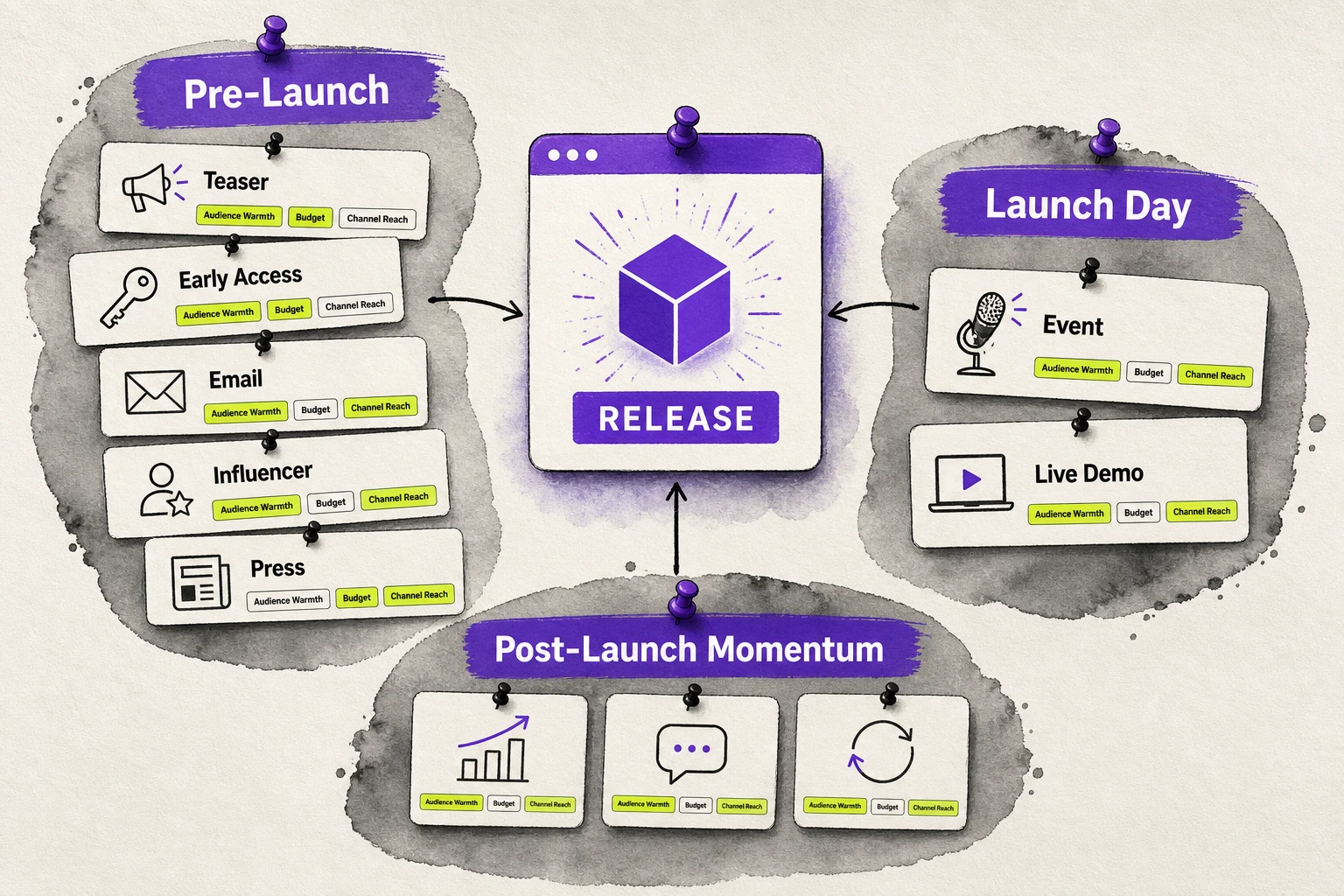
Timing changes the job of the tactic. An idea that works well before the launch date can fall flat on launch day, and a strong launch-day push may do little for post-purchase momentum. The simplest way to sort options is to ask what the reader needs from this stage first, then choose tactics that serve that job.
| Stage | Primary job | What good-fit tactics usually do |
|---|---|---|
| Pre-launch | Build attention and interest before the release | Create curiosity, warm interested buyers, and give people a reason to watch for the launch date |
| Launch day | Convert attention into action | Make the offer clear, reduce hesitation, and help buyers act while interest is highest on launch day |
| Post-launch | Extend momentum after the first push | Reinforce value, surface proof, and create follow-up reasons to buy, share, or stay engaged |
That is the key distinction: stages are not interchangeable. They represent different buyer needs, so the best tactic fit comes from sequencing ideas by timing rather than treating every launch idea like a standalone promotion.
Then Narrow by Audience Warmth, Budget, and Channel Reach
Once the stage is clear, the next question is fit. Audience warmth is how familiar and ready the target audience already is. In plain terms, it tells you whether a tactic should build trust first or ask for action now. Budget and channel reach do the same job: they cut mismatched ideas, not rank launch quality.
- Audience Warmth: colder audiences usually need education and trust-building, while warmer audiences can respond to direct offers or early access pushes.
- Budget: a lean budget usually works better with a few focused tactics than broad coverage.
- Channel Reach: choose ideas that fit the channels you can actually activate, whether that means an email list, social presence, partner network, or existing community.
With that filter in place, pre-launch ideas become easier to judge. The goal is to find the first tactics that fit.
Pre-Launch Product Launch Ideas That Build Anticipation Early
Pre-launch work has a specific job inside a product launch. Before anything can convert, people need a reason to notice, care, remember, or raise a hand. In practice, that means choosing tactics that build anticipation in different ways: some create curiosity, some capture early intent, some warm demand through repeated contact, and some expand reach through outside voices or visibility on social media platforms. The point is not to do all of them. The point is to choose the few product launching ideas that match how your audience pays attention before release.
- Use teaser campaigns when mystery or timing can build excitement before the full story is ready.
- Use early-access offers when a smaller group is already interested enough to commit before the wider product launch.
- Use email warm-up when you have permission to stay in front of people and guide them toward launch-day action.
- Use influencer or PR-driven visibility when borrowed reach can extend awareness beyond your own social media presence.
Teaser Campaigns That Give People a Reason to Watch
Teasers work when attention should arrive before explanation. A teaser campaign is a prelaunch message that reveals just enough to make the upcoming launch feel worth tracking, which is useful when the reveal itself is part of the appeal. This fits marketing campaigns for products with a visible moment ahead, a clear release date, or a strong visual angle that can express the brand's personality without explaining every feature at once.
- Best Fit: an upcoming launch where suspense, visuals, or a staged reveal make people more likely to watch for the next update.
- Why It Works: It gives the audience a simple reason to pay attention now instead of waiting until the product is fully live.
- Weak Fit: an offer that needs immediate detail, pricing context, or proof to make sense. In that case, teaser campaigns can create empty clicks instead of real interest.
Early-Access Offers That Pull in Your Most Interested Buyers
Early access works best when interest already exists and exclusivity adds meaning. Instead of trying to persuade everyone at once, this tactic gives a smaller group a reason to act sooner, which helps separate passive attention from real buying intent. That usually makes sense when loyal customers, subscribers, or waitlist signups already trust the brand and want first access more than a public countdown.
- Best Fit: an audience segment that already wants the product and sees early access as a real benefit rather than a random restriction.
- Why It Works: it rewards existing interest, creates a cleaner signal of demand, and can surface valuable feedback before the wider release.
- Weak Fit: a cold audience with no relationship to the offer. If people do not already care, exclusivity can feel arbitrary instead of motivating.
Email Marketing That Warms the Right Audience Before Launch Day
Email marketing is an owned pre-launch channel, which means the brand can return to the same audience more than once before launch day. In simple terms, it works when people have already given permission to hear from you and the offer needs a few touches to become clear, relevant, and timely.
A simple pre-launch sequence might start with a short announcement to potential customers, follow with a message that explains the problem the product solves, and end with a reminder as launch day gets closer. That sequence does more than repeat the same point. It lets email marketing move from awareness to understanding to readiness, which is why it is stronger than one isolated send when the audience needs warming rather than a surprise reveal.
This is a strong fit when the list is relevant and engaged. It is a weak fit when the brand has little list quality, little segmentation, or no clear reason for repeated contact before launch day.
Influencer Marketing That Adds Reach Before the Release Goes Live
Influencer marketing earns its place when borrowed reach is more valuable than more posts from the brand alone. The core question is not audience size. It is whether the creator's audience overlaps with the buyers you want, trusts that creator's recommendations, and can understand the product quickly enough to care before launch.
- Choose it when the creator already speaks to the right niche and can frame the release in a credible way.
- Avoid it when the partnership adds visibility but little relevance, because broad attention without fit rarely helps pre-launch momentum.
- Treat influencer marketing as a reach multiplier, not a substitute for your own message, waitlist, or email capture.
Press Releases That Help You Earn Media Coverage Before Launch Day
Press releases are a narrow tool, not a default pre-launch move. They make sense when the launch has a real news hook, such as a meaningful partnership, a notable milestone, a timely market angle, or a release with wider industry relevance. Without that hook, press releases often create activity without much return.
- Use PR when there is a clear reason an outside publication or reporter would consider the announcement news, not just promotion.
- Do not assume a release will generate press coverage on its own. Distribution is not the same as interest.
- If the story is weak, put the effort into channels you control before launch day and save outreach for a stronger angle later.
Launch-Day Ideas That Turn Attention Into Action
Pre-launch work creates interest. Launch day has a different job: turn that interest into action while the official launch is still fresh. The best tactic depends on the buyer friction in front of you. Some launches need a shared moment around the new offering, some need a faster explanation, and some need clearer prompts that support customer acquisition.
- Use a launch-day focal moment when the release needs concentrated attention.
- Use explanation-first tactics when the value becomes clearer in motion than in copy alone.
- Use CTA reinforcement when buyers already understand the offer but need a direct reason to act now.
- Use real-time objection handling when unanswered questions could block commitment.
A Product Launch Event When You Need a Shared Moment Around the Release
Some releases need more than a page update. When a shared moment itself increases attention and recall, the event becomes the tactic, not just the container. That is when a product launch event can give the product launch more visibility and make the moment easier to remember.
- Broad Audience Reach: Choose virtual events when a successful product launch event needs scale more than atmosphere. This launch event fits software or distributed audiences, where a successful product launch depends on getting many people to the same moment at once.
- Hands-on Impact: Choose in person events when handling the offer changes understanding. This product launch event is a stronger fit for hardware, retail, or premium experiences, especially when interactive elements help the launch feel real.
- Visual or Story-Led Reveal: An effective launch event works when the release has reveal value, strong founder- or product-led storytelling, or a format that can turn a successful product into a visible moment rather than a quiet update.
- Low-Novelty Update: Skip the launch event when the audience would get the same value from a page, email, or demo. Not every product launch needs live production, and successful launch events still have to justify their coordination load if you want a successful launch and a launch memorable enough to earn the effort.
Live Demos When New Features Need a Fast, Clear Explanation
Some launches stall because the audience cannot picture the value quickly enough. A live demo solves that problem by showing the product in action, not just describing it. That matters when new features, key features, or security features only make sense once people see the workflow or result on screen.
This format fits products whose promise depends on movement or proof. If the product solves a visible pain point, a short walkthrough can connect the problem to the outcome quickly. For example, a software release can highlight key features by showing a user completing a task faster, seeing how third party features fit inside the workflow, or understanding when other third party features reduce switching between tools. That makes the product features easier to evaluate because the audience sees what changed and why it matters.
A demo is less useful when the offer is already easy to understand from a page or image. Use it when the explanation gap is the real barrier.
Launch-Day Social Posts That Create Urgency Without Looking Repetitive
Launch-day social posts work best when each one does a different job. Repetition becomes a problem when every social media post says the same thing in slightly different words. A stronger approach is variation in CTA reinforcement: one post announces, another shows proof, another answers a likely hesitation, and another points back to the action readers should take.
- Lead with a distinct angle in each social media post, such as the release itself, a user outcome, a standout feature, or a timely reason to act.
- Keep the CTA explicit so the audience knows the next step, whether that is to sign up, buy, book, or watch.
- Use supporting proof that fits the post, such as a product image, a short clip, a customer quote, or a quick feature explanation.
- Match urgency to the offer instead of forcing hype. The message should feel current because the launch is happening now, not because the copy keeps shouting.
- Check adjacent posts before publishing so the language, image choice, and call to action do not sound copied.
Q&A Sessions When Buyers Need Real-Time Answers Before They Commit
Some buyers are interested but still stuck on one unresolved question. A Q&A session helps when live answers can clear the last barrier between interest and action. In practical terms, this is real-time objection handling. It gives the team a direct way to address pain points, clarify fit, and show that the offer can stand up to scrutiny in the moment.
- Use it when buyers are likely to ask setup, compatibility, implementation, or use-case questions before they commit.
- Use it when the launch includes interactive features or product details that static copy may explain too slowly.
- Use it when objections are predictable but still important, such as who the product is for, what problem it solves best, or what changes from the current option.
- Skip it when the likely questions are simple enough to answer on the page and the live format would add delay instead of clarity.
This tactic works because it deals with hesitation at the point where it appears. Once launch day passes, the job changes. The next question is how to keep early attention from fading after the first spike.
Post-Launch Ideas That Build Retention, Referrals, and Repeat Action
Launch day creates a spike. Post-launch work determines whether that spike turns into staying power. After the product is live, the job changes from announcement to follow-through, which means using creative ideas that help people trust the offer, come back to it, talk about it, and succeed with it.
- Proof: use customer stories and user-generated content to show what the product looks like in real use and encourage customers who are already seeing value to share it publicly.
- Reactivation: use a second push when interest was real but action stalled, giving warm prospects a timely reason to return without repeating launch-day hype.
- Advocacy: prompt early buyers to share wins, reactions, or setup moments so satisfaction becomes visible to other buyers.
- Onboarding: guide new customers from setup to early success so the purchase leads to adoption, not confusion.
Customer Stories and User-Generated Content When Social Proof Matters Most
Interest often fades after launch because buyers have seen the promise but not the proof. This is when social proof matters most. Real examples from early customers can reduce hesitation by showing how the product fits into actual use, not just polished campaign language.
A customer story works best when the product has already produced a visible outcome, such as a faster workflow, a simpler setup, or a clearer result. User generated content works similarly, but it usually feels less formal. A screenshot, short post, or quick video can show that the product is in use by a real person, not user speculation from someone who has only seen the announcement.
The strongest use case is a launch that needs trust more than reach. If buyers are asking whether the offer delivers, customer stories and user generated content answer that question in a more credible way than repeating brand claims. That makes proof a better next move than more urgency.
Limited-Time Follow-Up Offers When Early Interest Needs a Second Push
Some launches do not need a bigger discount. They need a better reason to come back. A follow-up offer can create that second push when the first wave produced clicks, sign-ups, or product views but left too many interested buyers undecided.
- Use it when interest was clear and the hesitation looks temporary, such as delayed decisions, crowded inboxes, or buyers who needed one more prompt.
- Keep the offer connected to the launch story so it feels like an extension of early momentum, not a sudden price drop with no context.
- Make the next action simple. The reader should know exactly what to do, what they get, and why the window is limited.
- Avoid using a limited-time follow-up offer as a default habit. If every launch ends with the same push, urgency loses credibility and positioning weakens.
Used carefully, a follow-up offer reactivates interest. Used carelessly, it trains buyers to wait.
Community Prompts That Turn Early Buyers Into Visible Advocates
Advocacy usually starts with a prompt, not a program. Early buyers may be happy, but they still need a reason to post, comment, or show what they did with the product. The right prompt turns private satisfaction into customer engagement that other buyers can see.
- Ask buyers to share their first result, first setup, or first reaction so the prompt feels specific and easy to answer.
- Tie the prompt to a visible moment, such as an unboxing, a before-and-after comparison, or a screenshot of the first win.
- Feature selected responses in your own channels to show that participation gets noticed and to reinforce the path from buyer to brand ambassadors.
- Keep the bar low. Short prompts create more participation than open-ended requests for a full review or detailed case study.
This works best when the product gives people something concrete to show, describe, or celebrate. Visible advocates rarely appear on their own. They usually need a clear invitation.
Onboarding Content When New Customers Need Help Seeing Value Quickly
A sale does not secure adoption if the product still feels hard to start. Onboarding content matters most when new customers need help reaching value quickly. In practical terms, that means reducing time to value between purchase and the first useful outcome.
- Start with setup guidance. Show the few actions that get the customer into the product correctly, especially if the first session includes account creation, installation, configuration, or data entry.
- Move to the first meaningful task. After setup, guide the customer to one small win that proves the product works for their real job.
- Add simple examples. A short walkthrough, checklist, or sample use case helps the customer understand what good early use looks like.
- Answer the common friction points early. If users tend to stall at one step, address that step before confusion grows.
- Point toward the next milestone. Once the first win happens, show what comes next so usage continues instead of stopping after the initial success.
This sequence is especially important for products with more complexity, more features, or a longer learning curve. When customers can see value quickly, retention has a stronger foundation. That is also the moment when a long list of launch tactics needs a fit filter. The next step is choosing which options actually match your product, budget, and audience.
Which Launch Ideas Fit Your Product, Budget, and Team Size
By this point, the challenge is no longer finding a product launch idea. It is cutting a long list down to the few tactics that fit the product, the budget, and the audience you can realistically reach. A successful product launch usually comes from product-type fit and clear execution, not from using every possible product launch tactic at once. The table below gives a quick filter before the narrower comparisons that follow.
| Constraint | Usually worth emphasizing | Usually worth trimming back |
|---|---|---|
| New product needs explanation | Live demos, early-access offers, onboarding-oriented follow-up | Broad awareness tactics without a clear next step |
| Offer depends on excitement or visual appeal | Teaser campaigns, launch events, social posts, creator or press amplification | Text-heavy education without a strong visual hook |
| Lean team or limited spend | Email, community, customer stories, a few high-fit channels | Too many parallel campaigns across every channel |
| Audience is smaller but reachable | Direct outreach, Q&A sessions, early-access sequences | Reach-first plays that need large top-of-funnel volume |
| Audience is broader and colder | Press, influencer reach, shareable launch content | High-touch tactics that require one-to-one activation at scale |
What Works Best for SaaS, Physical Products, and Community-Led Launches
Different launch models reward different kinds of momentum. That does not mean SaaS, physical products, and community-led launches must stay in separate boxes. It means each one tends to respond better to a different mix of explanation, proof, and participation.
| Product type | What usually matters most | Tactics that often fit best | What to watch for |
|---|---|---|---|
| SaaS | Fast understanding of the problem, workflow, and payoff | Live demos, email sequences, early-access offers, Q&A sessions | Too much hype before buyers understand how the product helps |
| Physical products | Visual interest, timing, and confidence in the buying moment | Teaser campaigns, launch events, influencer marketing, press coverage | Awareness without enough product detail, availability clarity, or social proof |
| Community-led launches | Participation, identity, and visible member enthusiasm | Community prompts, early-access offers, customer stories, user-generated content | Pushing polished brand messaging when member-to-member energy should lead |
A simple way to think about product-type fit is this: SaaS often needs explanation first, physical products often need visibility and desire, and community-led launches often need participation people can see and join. Those are tendencies, not rigid rules, but they help remove tactics that sound exciting and function poorly in the actual launch context.
When a Lean Budget Calls for Focus Over Coverage
Budget pressure usually makes prioritization easier, not harder. When resources are tight, lean-budget focus means choosing a smaller set of tactics you can execute well across the full launch window instead of scattering effort across every channel and hoping the pieces function properly.
- Favor owned channels first, especially email, community spaces, and social formats you already use consistently.
- Choose tactics that can work across stages, such as teaser content that leads into launch-day posts and post-launch follow-up.
- Put effort into one strong conversion path instead of several weak ones, so interest has a clear next step.
- Reuse proof where possible, including customer quotes, demo clips, or Q&A answers that can appear in more than one asset.
- Trim tactics that require heavy coordination or broad reach if you cannot support them with enough follow-up and response capacity.
How Audience Size Changes the Tactics Worth Your Time
Audience size matters, but reachable audience matters more. In practice, the key question is not how many people exist in theory. It is how easily the launch can activate target customers through channels, trust, and timing that already exist.
| Audience situation | What it usually means | Tactics more likely to fit |
|---|---|---|
| Smaller but highly reachable | People already know the brand, follow updates, or respond to direct outreach | Email marketing, early-access offers, Q&A sessions, live demos, community prompts |
| Broader but harder to activate | Awareness exists, but attention is diffuse or less committed | Influencer marketing, press releases, teaser campaigns, launch-day social posts |
| Mixed audience | A warm core can engage early while a wider group needs simpler entry points | Use a two-layer plan: direct tactics for the core and shareable awareness tactics for everyone else |
This is where reachable audience becomes a useful filter. If the audience is warm, tighter conversion tactics usually deserve more time. If the audience is colder, awareness tactics help more, but they still need a clear path into the shortlist the next team will execute.
How to Turn Product Launch Event Workflows Into a Coordinated Plan for Cross-Functional Teams
Once tactics are filtered, the next job is execution. A strong product launch event plan keeps the launch event focused inside the broader product launch process: choose the few tactics that matter most, name cross functional teams and owners early, and add handoff checkpoints before customer-facing work goes live.
- Use stage-based prioritization so product launch event workflows stay manageable across pre-launch, launch day, and follow-up work.
- Assign ownership before multiple teams create assets, approvals, or customer messaging for the product launch.
- Review handoffs so launch planning can hold up across multiple launches, shifting details, and coordination pressure.
Choose a Few Tactics per Stage Instead of Trying to Do Everything
More activity does not create a better launch. Stage-based prioritization means choosing the few actions that fit each stage and dropping ideas that add coordination without adding impact.
- Tie each tactic to one stage-specific job, such as building anticipation, driving launch-day action, or sustaining follow-up momentum.
- Favor tactics your team can execute well with the channels, assets, and approvals already available.
- Remove duplicate tactics that reach the same audience in nearly the same way.
- Cut low-value work that creates extra dependencies across teams.
- Leave room for execution quality, follow-up, and adjustments instead of filling the plan with every possible idea.
Assign Owners Across Marketing, Product, Sales, and Support Early
Ownership should be clear before assets start moving. Early cross-functional ownership reduces overlap, speeds approvals, and makes launch day sales enablement easier because each team knows what it must deliver and review before the release goes public.
| Function | Primary ownership | Key handoff |
|---|---|---|
| Marketing | Campaign assets, channel timing, audience messaging | Shares launch-ready copy and schedules with product, sales, and support |
| Product | Feature accuracy, demo inputs, release readiness | Confirms what is shipping and flags changes that affect messaging or launch day materials |
| Sales | Prospect conversations, objection handling, sales enablement use | Turns launch messaging into customer-facing talk tracks and feedback for the team |
| Support | Help content, issue routing, customer response readiness | Prepares for incoming questions and returns common friction points to marketing and product |
Build Checkpoints for Delays, Handoffs, and Last-Minute Changes
Even a focused plan can slip when teams assume someone else caught the issue. Handoff checkpoints help the team track progress, surface blockers, and protect customer-facing work during this launch and future launches.
- Review dependencies before launch-facing assets publish, especially when one change affects several teams or channels.
- Confirm that each handoff has a clear reviewer, a decision owner, and a fallback path if details change late.
- Check pages, emails, and support content together so future events and the next launch do not repeat the same gaps.
- Use a lightweight review note to track progress on open issues instead of relying on memory or scattered replies.
- Separate launch-readiness checks from later reporting work so the core handoff is complete before teams review key performance indexes or how cookies track visitors.