

The most important factor of email marketing is relevance to the recipient. A message should address a problem, decision or interest the person has reason to care about now. A beautiful template, clever subject line or perfect send time cannot compensate for the wrong message to the wrong audience. Relevance is not a feeling the sender has about the campaign. It is a claim you should be able to explain before sending and test against what recipients do afterward.
In short: Start with people who are eligible to receive the message and a delivery setup that works. Then match one specific audience need to one useful email and an appropriate next action. Diagnose results in order: who could receive it, who received it, who acted, and whether the action advanced the campaign's actual goal. Open rate alone is a weak judge.
This guide is for a US team sending newsletters, nurture emails or targeted product updates to an audience it can legitimately contact through its chosen platform. If you mean a first unsolicited approach to a B2B prospect, use the email outreach starting guide for that different job. The audience, platform and compliance checks differ. If your campaign is already running, jump to the diagnosis.
Why relevance comes before subject lines or send time
Imagine two subscribers. One downloaded a guide to routing demo requests between sales teams. The other signed up for product release notes. Both are valid contacts. An email about territory handoffs could help the first person and interrupt the second. Changing the subject line from “Routing guide” to “A quick idea for you” does not repair that mismatch.
Mailchimp describes segmentation as dividing subscribers into groups so content can match their needs. That is a mechanism for relevance, not proof that every smaller segment performs better. The useful question is: What do we know that makes this topic a reasonable fit for these people? A role, signup promise, stated problem, recent request or product use can answer it. A first-name field cannot.
Relevance also changes with time. A buyer who asked for an implementation checklist may appreciate it this week; after the project is canceled, a five-email implementation series becomes noise. A good program updates or stops when a reply, purchase, opt-out or changed status makes the original reason for sending obsolete.
Three gates a relevant email still has to pass
Relevance is the central editorial choice, but three other conditions can block a campaign. Treat them as gates rather than competing slogans about “the one most important factor.”
- Contact eligibility. Check three distinct obligations before sending:
- US commercial-email rule: For an email whose primary purpose is commercial, the FTC's CAN-SPAM guidance calls for accurate From, To, Reply-To and routing information; a truthful subject; clear identification that the message is an advertisement; a valid physical postal address; a working opt-out method; and prompt honoring of opt-outs. These requirements apply to B2B commercial email too. Federal law does not impose universal advance opt-in for it.
- Platform permission: Your sending service can be stricter. For example, Mailchimp defines marketing permission as express and verifiable. Check the policy of the service you actually use.
- Current suppression: Check the person's current status before every send. An opt-out stops marketing, however relevant the message seems to the sender.
- Inbox access. Configure the sending domain and message according to the receiving provider's rules. Google's sender guidelines give the current technical requirements for personal Gmail destinations. They distinguish requirements for all senders from additional requirements for those sending more than 5,000 messages a day to those accounts. Authentication, complaint control and the applicable unsubscribe mechanics help prevent avoidable delivery problems. They do not guarantee inbox placement or make an irrelevant message useful.
- A real next step. Give the reader something they can actually use: an answer, checklist, comparison, event or clear decision. If the email asks for a click, the destination must keep the promise made in the email. A great topic attached to a broken form cannot achieve the campaign's goal.
These are necessary checks, not a ranking of who deserves the “most important” label. If eligibility or delivery is broken, fix it before judging copy. Once the message can be sent and received, recipient relevance is the best place to decide what to say.
The five-question relevance test before you send
For one proposed email, write one sentence for each question. If the answers are vague, postpone the send and find the missing evidence.
- Who exactly is this for? Define the smallest useful group by a known need or action, not an arbitrary demographic. “RevOps managers who asked about demo-request ownership” is more actionable than “all managers.”
- Why should they care now? Name the trigger or current job: a requested guide, renewal decision, changed product workflow or question they asked. If timing is an assumption, say so internally and test it rather than pretending to know their situation.
- What did we promise them? Compare the topic with the signup form or prior exchange. Someone who opted in to product notices did not necessarily ask for a general sales newsletter.
- What does this email help them do? Give one useful answer before asking for a meeting or click. If the answer requires a landing page, make the link lead directly to it.
- What would tell us it was useful? Choose an observable action tied to the job: a completed download, qualified reply, booked meeting, activation step or purchase. Also watch opt-outs and complaints as reasons to inspect the match. Do not call a tracked open proof of interest.
This test prevents a common misuse of “personalization.” A message can include a person's name, company and industry and still be irrelevant. The practical personalization is in the reason for sending and the answer offered.
A worked example: one list, two different jobs
Consider a fictional B2B software team with 200 eligible subscribers. All 200 joined through the company's own forms and can receive this type of marketing email under the team's platform policy. The group contains 120 people who requested material on demo-request routing and 80 who subscribed to product release updates. The team wants qualified conversations about a new routing workflow.
A single email to all 200 announcing “See our new workflow” treats the list as one audience. It gives the first 120 no help deciding whether the workflow solves their handoff problem and gives the other 80 a product message that may be expected, but is not connected to the campaign's conversation goal. Both groups may be eligible for some marketing under the stated platform policy. That does not establish delivery or make this message relevant to both groups.
A more relevant plan separates the jobs:
- 120 routing subscribers: Send a short note explaining one failure mode: a request can be accepted by nobody when territory ownership changes. Offer a one-page ownership check and invite a reply about the step that breaks in their team. Send only if that guide is ready and the email fits the original signup promise. For a longer educational program, the lead nurturing guide covers entry, handoff and exit rules.
- 80 release-note subscribers: Send the release note they asked for, if the update is relevant to their subscription. Do not count them in the routing conversation campaign merely because they are on the same database. If there is no useful release to announce, do not invent one to fill a calendar slot.
Here is an illustrative subject-and-body copy sketch, not a send-ready email. Before sending a US email whose primary purpose is commercial, use accurate From, To, Reply-To and routing information; a truthful subject; clear identification that the message is an advertisement; a valid physical postal address; and a working opt-out method. Honor opt-outs under the FTC's CAN-SPAM guidance. Also confirm that your sending platform permits this audience and that the promised guide and link actually work. The sketch leaves real sender and footer details to the sending organization:
Subject: Who owns a demo request when territories change?
If a new demo request arrives during a territory change, who accepts it, who can reassign it, and who checks that it was actually picked up? Our one-page ownership check walks through those three decisions. [Read the ownership check.] If your team already has a handoff rule but requests still stall, reply with the step that breaks and we can focus on that question.
The link text describes a guide that must exist and work before sending. The email does not pretend to know the recipient's current system. Its reason for arriving is the routing topic the group requested, and its question invites a specific answer rather than a generic “interested?”
Suppose the first group receives the routing note. In an illustrative review window, 100 of 120 emails are delivered, 12 people click the ownership check, 4 send a substantive reply, 2 request a meeting, and 1 opts out. These numbers are invented to show the measurement logic, not a benchmark or claim about actual campaigns. The two meeting requests might be among the four replies; do not add them to make six distinct people. Investigate the 20 messages not delivered before interpreting the rest as a copy result.
The first question is whether those 100 delivered recipients matched the stated problem. Read the four replies: did they raise an ownership issue, or did they say the topic was wrong? Check whether the twelve clicked the guide that the email promised. Ask why one person opted out. If replies show a wrong assumption about the audience, improve the audience definition or content. If the form fails after a click, fix the destination. A higher open count would not settle any of these questions.
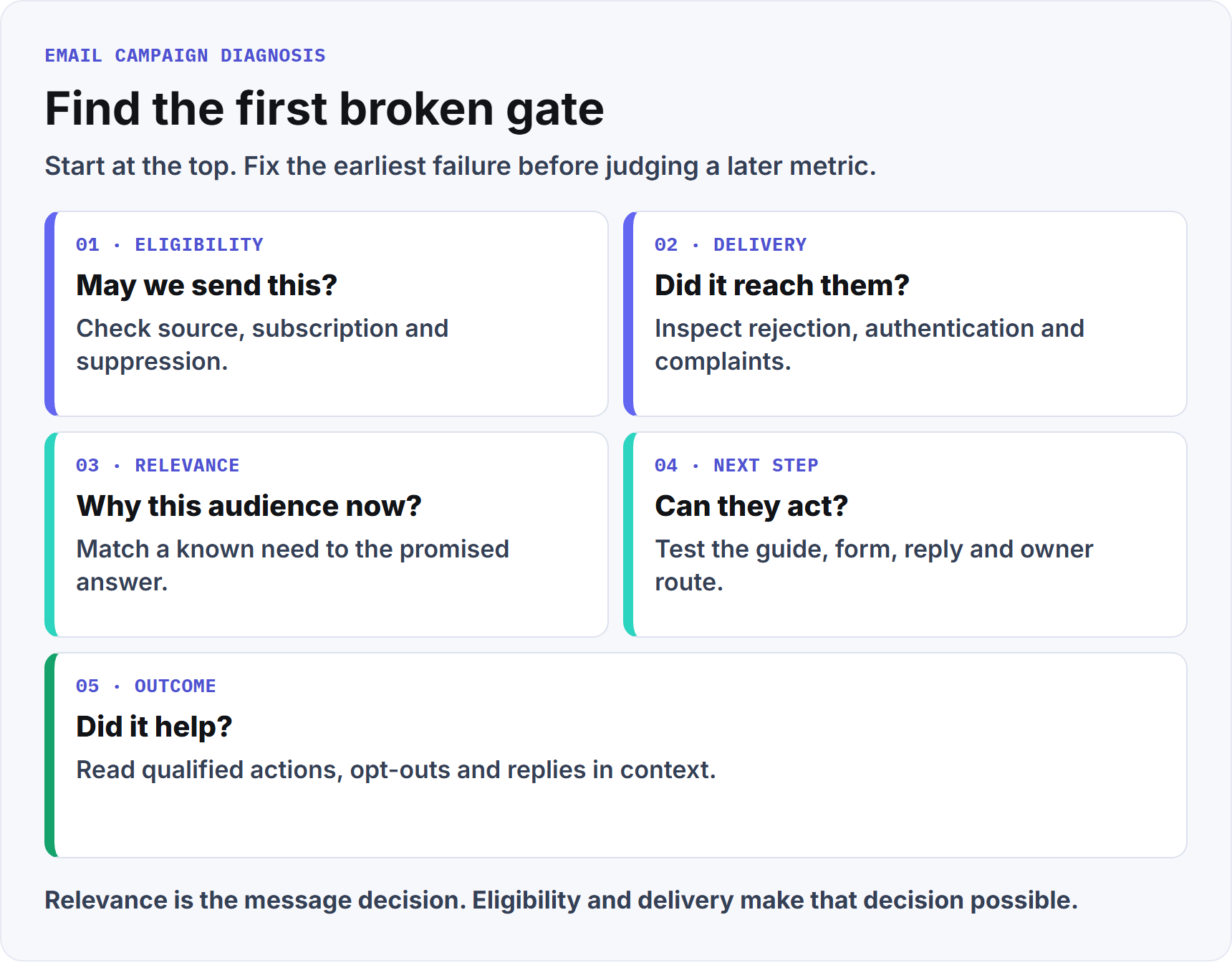
Diagnose a weak campaign in the right order
Start with the earliest point where the intended recipient could not take the intended action. That keeps the team from rewriting subject lines when the actual problem is suppression, bounce, topic mismatch or a broken page.
- Eligible audience is small or unclear: Verify source, subscription state, suppression and the original promise. Do not quietly reclassify contacts to increase send volume.
- Accepted delivery is weak: Check authentication, bounces, complaints and provider guidance. A delivered count does not prove inbox placement, but a rejected message cannot generate a valid response.
- Delivery is sound but useful action is scarce: Read replies and compare the email with the known need. Review the subject and preview text for a truthful promise, but do not assume a subject-line change fixes the offer.
- People click but do not complete the goal: Open the destination on mobile, check that the promised content is visible and the form or booking route works. Also ask whether the call to action asks for too much too soon.
- People act but the business result is weak: Check qualification and follow-up. A meeting that never receives an owner is an operational loss, not an email-copy failure.
Assign each diagnosis to the person who can fix it: the list owner for eligibility, the email operations owner for authentication or rejected delivery, the campaign owner for audience and message fit, the web owner for the destination, and the sales owner for accepted conversations. A dashboard that shows a drop without a named next action is only a report.
Measure with a fixed cohort and window. Compare delivered recipients with meaningful actions, but keep the definitions clear. A reply, click and meeting may come from the same person. Avoid summing them into a fake total of “engaged contacts.”
Mailchimp's Apple Mail Privacy Protection FAQ explains why open reporting may be inflated or distorted for Apple Mail users who enable that protection. Opens may help spot a gross change, but they cannot reliably tell you whether a person read or valued a message. Clicks and replies also have limits: a click does not prove intent to buy, and a reply can be negative. Read the action in context.
What if another factor is the immediate bottleneck?
If your domain is not properly configured or messages are being rejected, deliverability is the immediate constraint. If the list contains people who opted out or do not meet the sending platform's rules, eligibility is the first constraint. If an offer has no genuine use for the audience, a beautifully segmented list will not rescue it. “Relevance is most important” describes the core message decision after the basic gates work; it is not an excuse to ignore whichever gate is broken today.
For a newsletter with a broad audience, relevance may mean a clear editorial promise and sections people can choose from, not a separate automation for every interest. For a one-to-one sales reply, it may mean answering the exact question asked rather than applying a marketing segmentation rule. The test remains the same: can you explain why this person should receive this answer now?
The first campaign to improve
Pick one audience whose source and message eligibility you can verify. Write down the need you have evidence for, the promised next step and the one action that would mean the email helped. Draft the message; have someone unfamiliar with the campaign read the email and destination together. Test the send, reply, opt-out and destination routes before sending to the audience.
Afterward, examine the first meaningful actions and the people who leave. If the campaign fails, identify the earliest broken gate, assign its owner and change that part before the next send. A B2B team using automated, permission-appropriate follow-up can use Alore's Drip Campaigner for templates, personalized sequences, follow-up reminders and campaign analytics; the audience choice and message judgment still belong to the team.
The most important email marketing factor is knowing why this message belongs in this recipient's inbox and being willing to change course when the evidence says it does not.