

For a first email to someone new, start with a simple greeting, then tell the person why you chose to contact them. Connect that reason to a question, useful offer, or request they can judge for themselves. If you cannot verify the connection or explain its relevance, do not invent a personalized opening. A direct, honest sentence will serve the reader better than a compliment that could be sent to anyone.
In short: Write down the real context before you draft: a referral you may name, a public fact that matters to your offer, a conversation you actually had, or the recipient's role when no stronger signal exists. Put that context in the first line and make the connection in the second. Then choose one proportionate next step: a small question or offer for a new contact, or delivery of a resource you genuinely promised. The examples below show how those lines change with the relationship.
What Should the First Two Lines Do?
A greeting and an opening line have different jobs. “Hi Maya,” addresses the reader. The next sentence must answer the question an unfamiliar sender creates: Why am I receiving this? The sentence after that should show why the answer matters to this person, without claiming to know a problem they have not described.
Use this short preparation note before writing:
What I know: [a fact I can verify or a conversation I had]. Why it may matter: [a connection to this person's work, stated as a possibility when uncertain]. What I can offer or ask: [one useful next step I can actually deliver].
The note stays with the sender; it is not a three-part formula to paste into every email. If “what I know” is merely a purchased job title, say so in your reasoning. A title may justify a role-based question, but it does not prove a current project, budget, or desire to talk.
For a general guide to professional greetings and opening lines, use Alore's broader email-starting article. Here we are solving the narrower problem of a first direct email to a new contact, whether introduced by someone, met briefly at an event, or approached cold. The distinction matters because a reply to a customer, a note to a colleague, and an unsolicited sales email do not have the same context or permission.
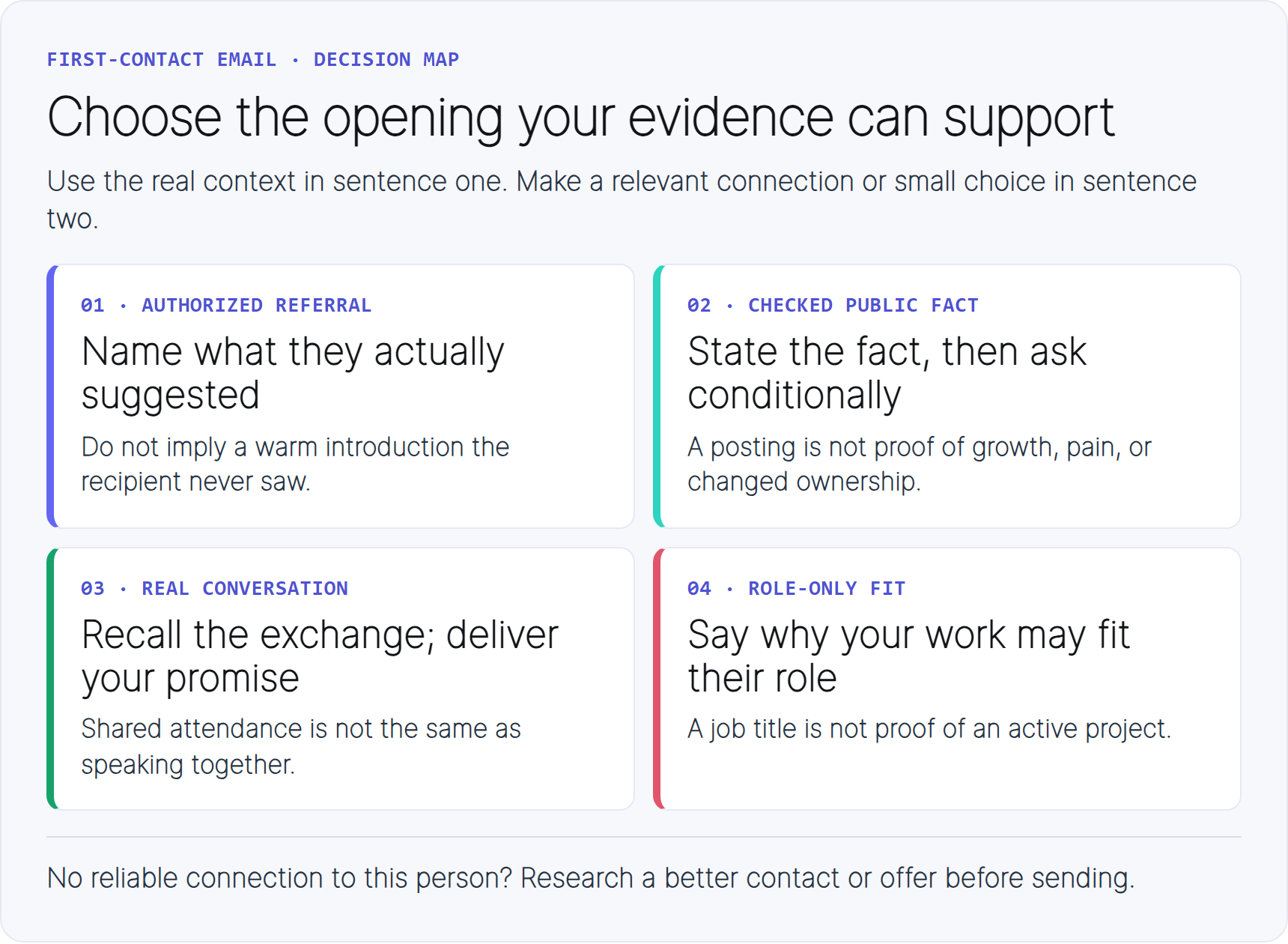
Start With a Referral, Public Fact, Conversation, or Role
The four examples below are fictional. They show sentence logic, not a claim that these messages were sent or produced replies. Before adapting one, swap in your verified person, event, page, or role and an offer you can actually make. Do not name a person as a referrer unless they agreed to be named; do not imply an event conversation happened if you only attended the same event.
1. A mutual contact gave an authorized referral
Hi Maya,
Jordan Lee suggested I contact you about demo-request handoffs. Would a short owner-handoff checklist be useful, or is someone else closer to that process?
This is a referral Maya may not have seen. It works only if Jordan made that suggestion, gave permission to use their name, and the seller has the checklist to send.
If Jordan actually introduced both people in a message Maya received, say ‘Jordan connected us’ instead. “Jordan thought you'd love our product” would be a different, unsupported claim unless Jordan actually said it.
If the introduction is warm and the recipient already saw Jordan's note, a shorter version may work: “Jordan connected us about demo-request handoffs. I can send a short owner-handoff checklist, if useful.” The first message still needs a clear reason and an easy next step; it need not perform a formal self-introduction twice.
2. A public fact creates a relevant question
Hi Maya,
Your SDR job posting mentions assigning inbound demo requests across territories. If that work sits with your team, would a short owner-handoff checklist be useful?
The posting is an observable fact in this fictional scenario. Its mention of demo-request assignment makes the checklist relevant, but the posting does not show that Maya has a routing problem.
This opener fits only if the seller has the offered checklist and Maya plausibly handles the work. The question already makes one small offer, so do not add another ask.
“I noticed you are scaling rapidly and struggling with routing” makes two unverified leaps. A public hiring page does not show the company's pain, and it may not even mean the roles are new. Check the page and date before using the detail. If the posting has closed or the connection feels weak, choose a different reason.
3. You spoke at an event and promised a follow-up
Hi Maya,
We spoke after Tuesday's RevOps panel about duplicate owners on inbound requests. Here is the short exception checklist I promised: [link to the actual checklist].
This works because it recalls a specific shared moment and completes a real promise. In a real email, replace the bracketed placeholder with a working link to the promised checklist. If you merely saw Maya speak, write “I heard your panel comment about…” and check that you have represented her point fairly. Do not convert attendance into a claimed conversation.
A networking note may have a different next step from a sales pitch. If the purpose is to exchange perspectives, ask one question. If the purpose is to send a promised resource, send it first. Alore's networking email guide covers the rest of that message; this article is about the first contact line.
4. There is no reliable trigger
Hi Maya,
I work on demo-request routing for B2B sales teams and am writing because you oversee revenue operations at Northstar. Would a short example of how teams assign an owner when a request crosses territories be useful?
There is no invented funding event, flattering reference, or claim that Northstar has a routing problem. The sender's work and Maya's role are the stated reason. This example assumes the sender really does that work and has the example to send.
If either is false, the message needs a different offer. A role-based reason can be enough when the fit is plausible and the ask is proportionate; it does not excuse sending to a broad, unexamined list.
If you cannot connect your work to the recipient's role in one sentence, pause. Research a more relevant contact or improve the offer before reaching out. The absence of a public trigger is not an invitation to fabricate one.
To adapt any route, draft two sentences privately: Sentence 1: [true reason I chose this person]. Sentence 2: [a relevant connection and one useful next step I can deliver]. A cold note may offer a small choice; a promised follow-up may simply deliver the resource. Then remove the brackets and check every factual detail before sending. The same method works for a public procurement notice: name the notice, say why your offer may fit, and ask whether this person handles that work without claiming a purchase decision has been made.
Turn a Generic Opening Into a Credible One
Compare these two fictional starts for the same first-contact B2B note:
Weak: Hi Maya, I hope this email finds you well. I came across your company and wanted to introduce our sales platform. Do you have 30 minutes for a demo next week?
The line gives no verifiable reason for contacting Maya or concrete job to discuss, then asks for a long meeting before giving her a reason to take one. Real sellers often write a shorter version—“I wanted to introduce myself and see if we can connect”—but the missing reason is the same. A first-time reader should not need to decode a pitch before learning why it arrived.
Rewritten: Hi Maya, your team has separate demo forms for two product lines. I help sales teams check who owns each request; are you the right person to ask about that workflow?
The rewrite uses a public site observation only if the forms really exist. It asks whether Maya handles that workflow instead of assuming she does. If she confirms ownership, the sender can offer the checklist; if she does not, the sender can stop or find the right person.
The useful edit is not “add personalization.” It is to replace a generic self-introduction with true context → relevant implication → modest ask. Woodpecker's B2B outreach guide similarly emphasizes that the information used in a cold opener must connect logically to the proposition. That is editorial guidance, not evidence that any particular line will win a reply.
Carry the Same Reason Into One Small Ask
An honest opener can be undone by a large, unrelated ask. If the first line offers a checklist, the rest of the email should explain what the checklist covers and make it easy to accept or decline. Do not follow a small offer with a calendar demand, a product feature list, and several links.
Here is a fictional opening-and-ask excerpt continuing the public-fact example; the seller actually has the checklist mentioned. This is only an opening excerpt, not a send-ready commercial email. A full US commercial message also needs accurate sender and header details, applicable ad identification, a valid physical postal address, and a clear opt-out route. Check the linked FTC guidance and the rules that apply to the send:
Subject: Demo-request owner handoff
Hi Maya,
Your SDR job posting mentions assigning inbound demo requests across territories. If that work sits with your team, would a short owner-handoff checklist be useful?
The checklist covers temporary ownership and exception routes.
—Avery
This excerpt is not a universal template. It works only when the public detail is current, Maya's role is relevant, and Avery can deliver the promised resource. If those conditions fail, change the message or the recipient. For the broader sequence—list, sending setup, initial test and response review—see Alore's first outreach pilot guide. For full email structure and copy decisions, use the cold email guide.
Check the Opening Before You Send
Read the first two lines as if you were the recipient. Can you tell why this sender picked you and what useful next step follows? Then check the underlying evidence:
- Truth: Can you point to the actual introduction, conversation, public page, or role record? Did the referrer allow their name to be used?
- Relevance: Does the fact connect to this person's likely work, or is it a decorative detail? Are you careful about the difference between an observation and a guessed problem?
- Next step: Is there one useful step the sender can actually deliver: a small, answerable request for a new contact or the resource promised after a conversation?
- Eligibility: Is the contact source appropriate for this use, have prior opt-outs been suppressed, and does the message follow the applicable sending and US commercial-email rules? The FTC's CAN-SPAM guide explains the US baseline for commercial messages, including B2B email. The full compliance and sending workflow belongs to the team's owner, not to an opening-line template.
Avoid manufactured urgency, a false mutual connection, praise that could apply to anyone, a job-posting claim that is out of date, or a buyer problem inferred from a single public signal. “I hope you're doing well” is polite in many contexts; in an unsolicited first message it is rarely the most useful first sentence when it delays the actual reason. “I'm reaching out” is also grammatically fine. Follow it with about what, and why this person.
What If You Lack a Name or a Reliable Reason?
If you do not know the recipient's name, do not guess a name or title. “Hello team,” can work for a shared inbox, but a first-contact business pitch usually deserves research for the responsible person. If the job is a general inquiry to an organization, address the team and state the specific purpose immediately.
If you have a plausible reason but weak proof of need, ask a question or offer a resource; do not announce that you have diagnosed the company. If you have no reliable reason, no relevant offer, or no lawful and permitted way to contact the person, the right next step is not to send that email yet. Fix the missing part first.
The opening succeeds at its immediate job when a new contact can see why you chose them and what useful next step follows. The complete message must also identify the sender. A reply would be useful feedback, but the first line cannot guarantee one. Write from evidence you have and leave room for the recipient to correct your assumption.