

The most useful lead generation tips fix the first weak link between reaching the right buyer and starting a relevant sales conversation. Define one buyer problem, make a specific offer, choose a channel where that buyer can encounter it, give them a clear next step, and route their response to someone who can answer. More traffic will not solve a page that attracts the wrong people; a shorter form will not solve an offer nobody understands.
In short: Look at four stages: do the right people arrive, can they make a request, what did they ask for, and who answers? Fix the first demonstrated break, then check the next comparable group. A downloaded guide, a public work address and a booked meeting are different signals; do not count them as the same kind of lead.
This guide is for a small US B2B team starting or repairing a lead path. The examples are fictional, not Alore campaign results. No channel, form length or response-time rule guarantees more qualified leads.
What makes a lead generation tip useful?
A tip is useful when it identifies who should act, what to change and what observation would make the change worth keeping. “Post more content” does not say which buyer question to answer or how the reader reaches you. “Add a chatbot” says nothing about the prospect's need or who answers it. Start with the buyer's job and a path from discovery to a response.
For this article, a lead record is a person or organization with enough identity and context to evaluate a next step. It is not automatically a qualified opportunity. Your team may use different CRM labels; make its local criteria visible. Alore's Sales Leads guide goes deeper on lead criteria, qualification and tracking. Here the practical question is: Which part of the path prevents a relevant person from reaching an appropriate next action?
Keep three distinctions in view:
- Source is not fit. A referral may be excellent or irrelevant; an ad click may be curious or serious. Check the account and request.
- Interest is not readiness. A guide download shows interest in that resource. It does not prove authority, budget or a request for a demo.
- Volume is not progress. More form fills are useful only if the right people get a relevant answer and the team learns why others leave.
Find the first weak link in your lead path
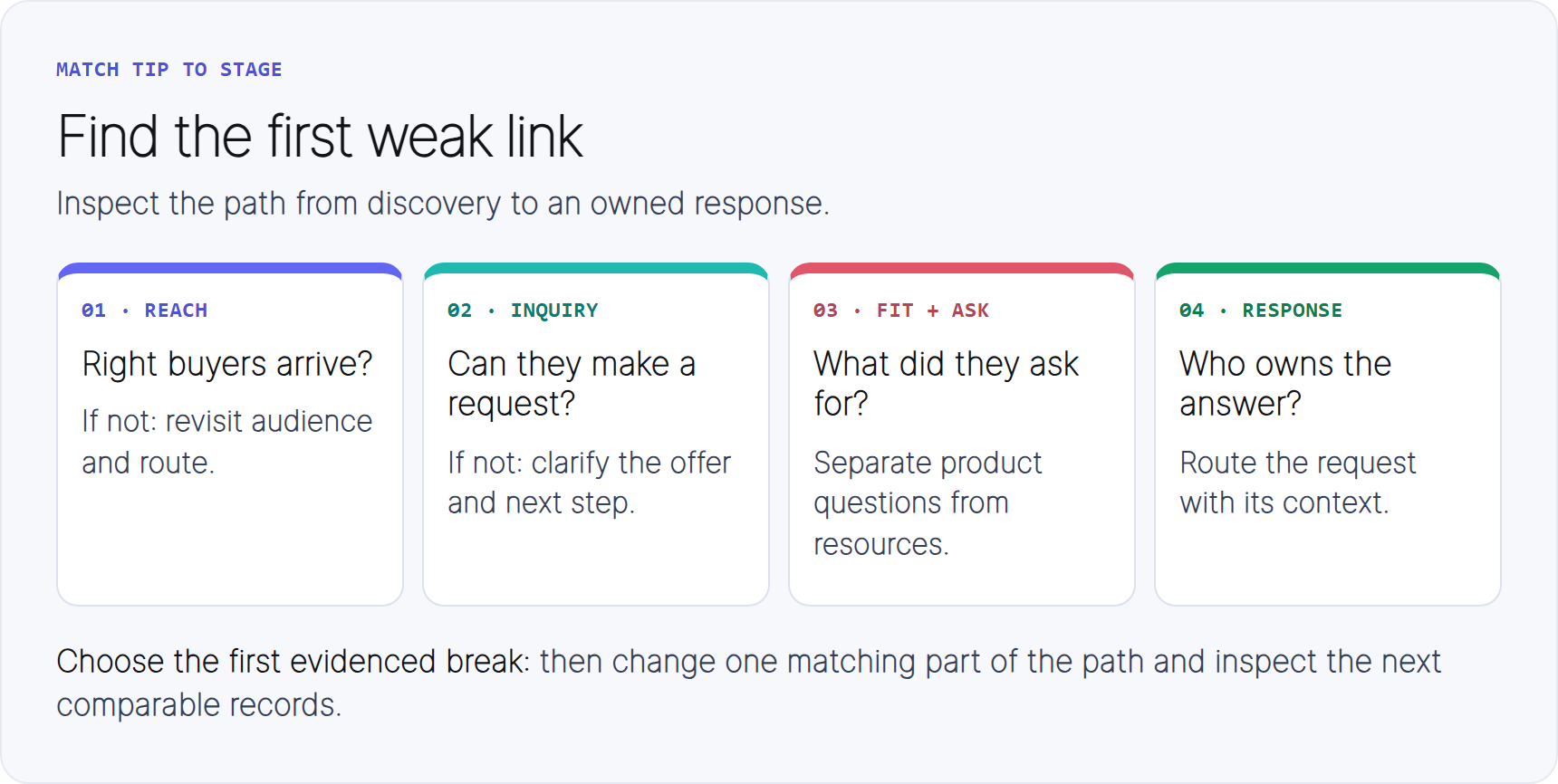
Before choosing a tactic, inspect relevant reach → inquiry → fit and request → owned next action. A form-record sample can reveal fit and handoff problems; it cannot show who saw a page but never inquired. For the earlier stages, add available source, visitor and on-page evidence or ask buyers where they looked and what remained unclear. Keep unknowns as unknowns rather than assigning intent from a visit alone.
- Relevant reach: Inspect sources and the roles/accounts arriving, or ask a sample of buyers where they seek help. If the intended audience is absent or a source repeatedly brings the wrong people, change that source or its targeting; check whether the next comparable cohort contains more suitable visitors or accounts.
- Inquiry: Look at what suitable visitors actually see and do, plus their feedback. If they arrive but cannot find an answer or fitting next step, clarify the offer or CTA; check whether more of those visitors make a relevant request.
- Fit and request: Read the source promise and the submitted words. If many inquiries are unrelated or ambiguous, tighten the audience promise or the question you ask; check the mix of suitable, answerable requests among submissions.
- Owned response: Inspect assignment and response records for suitable requests. If they sit unowned or receive the wrong answer, fix routing; check whether each new suitable request gets its promised answer and a named next action.
These are diagnostic choices, not a rule that the first low percentage is always the cause. Compare like periods and sources; investigate the earliest evidenced break, while fixing a broken form or abandoned request immediately. The B2B marketing guide helps choose an overall channel; this article helps decide what to repair in a lead path.
Ten practical lead generation tips, matched to the bottleneck
1. Define one buyer job—and who is outside it
Use when relevant reach is scattered. Write one sentence that names a buyer role, a situation, the job they need to complete and why your offer belongs there. For example: “US field-service operations managers who lose work-order ownership during handoffs need a way to see who holds the next action.” That is a planning hypothesis, not a claim that every such manager has the problem.
Add an exclusion: companies too small for a multi-person handoff, job seekers and students are not the same audience. An exclusion keeps ads, content and outreach from being “relevant” only because they contain the same industry word. Check the sentence against actual conversations and records; firmographics alone do not reveal a current need.
First test: Marketing excludes a known irrelevant audience from one source. Check the role and request mix from that source in the next comparable period, while watching whether suitable inquiries disappear too.
2. Check for a buying moment without pretending it proves intent
Use when you know the industry but not why someone would act now. A new team, changed workflow, upcoming procurement review or public product release can suggest a timely question. Look for a verifiable signal and ask what it could reasonably mean. A company hiring field technicians may be growing service capacity; it does not follow that its work orders are mishandled or that it wants your software.
Use the signal to choose a helpful angle, not to announce a private diagnosis. If your evidence is thin, ask whether the problem is present. Record which signal led to a real discussion rather than declaring every public event “high intent.”
First test: The outreach owner uses one verifiable event to frame a question, then records whether prospects confirm the problem in their replies. If they correct the assumption, revise the signal rule.
3. Make the offer and proof specific to that job
Use when buyers visit or reply but cannot say what you solve. Replace “end-to-end productivity platform” with a task the buyer can assess: “See the current owner and next handoff on one work order.” Show how the proposed workflow operates, what must be true for it to work, and what is still unproven. A screenshot, documented workflow or approved customer example can be proof; a logo and an unqualified percentage are not substitutes.
One page can answer “Will this fit my process?” with a short before/after workflow and a limitation. If your team has no verified result, demonstrate the mechanism rather than inventing a lift. The next step might be a product question or a scoped evaluation, depending on what the reader needs to decide.
First test: The page owner replaces one vague claim with a concrete workflow and checks whether suitable visitors ask more specific fit questions rather than “What does this do?”
4. Build one page around a real decision question
Use when suitable buyers repeatedly ask an evaluation question your current pages do not answer. Write a page that answers one such question: how a handoff is assigned, what happens when an owner is unavailable, or how a service team compares two routing approaches. State the situation, decision criteria, example and limits. Then give the reader a next step that fits that decision. Tip 3 improves proof on a page buyers already reach; this tip creates a missing answer and a route to it.
Search can be a relevant discovery route, but a comparison page is not automatically “bottom of funnel,” nor does a title guarantee ranking. Google Search Central recommends people-first content that leaves the intended audience with enough to accomplish its goal. Check whether the page brings suitable readers and useful inquiries; do not publish a pile of generic articles merely to fill a keyword list.
First test: The content owner answers one documented buyer question and routes the page through a channel already used by those buyers—a relevant sales reply, partner resource or existing navigation. Check that suitable people actually reach it and whether their next questions become more specific. If search is the main route, allow time for discovery and inspect relevant search visits before judging inquiries.
5. Make the next step clear and appropriately easy
Use when suitable visitors read but do not contact you. Tell them what happens after they act. “See a sample handoff review” promises something different from “Talk to sales.” A guide request should deliver the guide; a demo request should reach someone able to discuss the product. Let a buyer ask a question when they are not ready for a meeting.
Remove form fields that do not help fulfill the request, while keeping the information needed to respond correctly. There is no universal three-field or five-field rule. Test the form on a phone and check where real users abandon it. A shorter form may increase submissions and also increase ambiguity; evaluate the resulting conversations, not only completions.
First test: The page owner tests one clearer CTA and verifies its destination and confirmation on a phone. Compare relevant requests and their clarity, not just button clicks.
6. Ask partners for a contextual introduction
Use when trusted specialists already help the same buyer job. A consultant who designs service workflows may know teams that are actively reviewing handoffs. Ask for an introduction only when the partner understands the fit and the buyer has agreed to be connected. Give the partner a short description of the specific problem you can discuss, not a generic pitch deck to blast to a list.
Record the introducer, why the account might fit and what permission or expectation came with the connection. A partner's endorsement can open a conversation; it does not convert the recipient into a subscriber or prove purchase intent. If introductions rarely fit, revisit the shared buyer job before asking for more.
First test: The partnerships owner briefs one partner on the fit and requested introduction; check whether referred people recognize the problem and welcome the specific follow-up.
7. Run a narrow, evidence-backed outbound pilot
Use when a defined account set has a plausible problem but is unlikely to find you through search soon. Choose one buyer role, offer, pain and desired outcome. Check that the person and organization fit; use a defensible reason for the message; write one argument and a small, relevant ask. Vikas's Cold Email Writing Guide treats follow-ups as new reasons to reply, not “checking in” repetitions. Alore's Cold Email Lead Generation guide owns the full pilot and reply-handling method.
A public work address is not evidence of subscription. For US commercial B2B email, the FTC's CAN-SPAM guidance covers truthful identity and subject, ad identification, a postal address, a clear opt-out and honoring stop requests. Provider requirements may also apply. Correct a bad contact source or an opt-out immediately; do not scale a list merely because few people replied.
First test: The outbound owner pilots a small verified account set and tags replies by confirmed problem, correction, decline and opt-out. Use those reasons to revise targeting before adding contacts.
8. Turn an event into an agreed follow-up, not a scanned list
Use when the team attends webinars, trade events or local business gatherings but cannot connect them to conversations. Decide before the event what buyer question you can answer. Ask a specific question in the session or at the booth, record what the person actually requested, and send the agreed item or answer afterward. “Met at event” alone does not say what a person wants next.
Separate a request for a recording, a question about implementation and an explicit sales meeting request. Each warrants a different response. If the event creates contacts but no clear buyer questions, change the event goal or audience rather than sending the same generic sequence to everyone who appeared on an attendee list.
First test: The event owner records the agreed follow-up for each actual conversation; afterward, check whether that answer was delivered and whether useful questions followed.
9. Route and answer inquiries with their context
Use when qualified requests stall after capture. An owner should see the source, the person's words, the account, what was promised and any objection or preference. The first response should answer the request: send the resource, resolve the question or propose a sensible conversation. Do not call someone who asked only for a guide as though they booked a demo.
Put an explicit owner and next-action state on each open inquiry. Salesforce describes lead management as capture, qualification, distribution and tracking; your actual labels and handoff criteria should fit your team. Alore's Drip Campaigner describes personalized sequences, reminders and analytics, but a tool does not decide whether a person is suitable or what they asked.
First test: The sales owner audits each suitable new request for assigned owner, promised answer and response. Investigate missing or mismatched answers before buying more reach.
10. Record why leads stall or leave
Use when the team wants another channel but cannot explain recent losses. Give each record a simple, revisable disposition: suitable with a current question, suitable but later, wrong role, wrong organization, educational interest, no usable contact route, declined, opted out, or unknown. The labels are local working categories, not a universal CRM taxonomy. Keep the person's actual words and the owner of the next step.
Review a small set of recent records. If many suitable people ask the same unanswered question, improve the page or response. If the page attracts job seekers, inspect its source and promise. If good conversations stop at a handoff, fix ownership. “Unknown” is a reason to investigate, not a license to assume purchase readiness.
First test: The RevOps owner labels ten recent records from their original words, keeps unknowns visible, and checks which repeatable loss reason deserves a source, page or handoff change.
A worked B2B lead generation audit
Imagine a fictional US field-service software team looking at 40 form submissions from one page during a two-week period. It initially calls all 40 “leads.” A record check finds 18 career inquiries, 10 records with too little account/request information to classify, and 12 plausible-fit business inquiries. Of those 12, five ask a product question and seven request a resource. The counts reconcile: 18 + 10 + 12 = 40; 5 + 7 = 12. They are illustrative numbers, not observed Alore results or conversion benchmarks.
This is an inquiry-quality slice, not a complete funnel audit: 40 submissions say nothing by themselves about suitable visitors who saw the page and left. The marketing owner checks source logs and form paths. In this fictional case, the logs show that 16 of the 18 career inquiries arrived through one paid search query about field-service jobs. The other two career records came from different sources. The team still needs visitor and source totals to judge the reach mix, but it has evidence of a specific source mismatch. The ten unknown records remain unknown until the team checks their original words and form data.
Chosen first test—tip 1, audience exclusion: Marketing removes the job-intent query from the buyer campaign and points genuine career seekers toward the careers path.
Sales has a separate duty: answer each of the five product questions and deliver the promised resource to each of the seven resource requesters. Those responses are not outcomes of the ad test.
Before comparing periods, marketing reconstructs the original campaign's visitor and inquiry totals. That includes how many of the 12 suitable inquiries and five product questions came from this campaign. If those source-specific counts cannot be recovered, the next period is prospective monitoring, not a before/after comparison.
In the next comparable two-week period, marketing checks campaign visitors, job-seeker submissions, suitable business inquiries and product questions. A lower share of job-seeker submissions with suitable conversations preserved would support keeping the exclusion; a drop in suitable inquiries calls for another look. A small sample cannot establish a general lift.
The source log makes tip 1 a defensible starting point; it does not prove that the landing page, form or other sources are healthy. If source data were missing, the team would label the cause unresolved rather than guessing. The next audit would look at suitable visitors who did not inquire and at the ten ambiguous records.
How should you measure and change the next test?
Compare the same source and period where possible. Count relevant visitors or reached accounts separately from submissions; a visit alone does not prove fit. Then record what each person asked, whether the team could help, who answered and what happened next. State each denominator: suitable inquiries among which submissions, and answered questions among which suitable requests.
Change one plausible weak point at a time when practical: source targeting, offer clarity, next-step wording or routing owner. Keep the others as stable as possible for comparison. A tiny sample can suggest where to investigate, not prove a universal winning tactic. Fix obvious harm immediately, including a broken form, false promise, misrouted inquiry or ignored opt-out; a tidy experiment is not more important than serving the person who responded.
Lead volume, cost per lead and form completion rate can help explain a path, but none alone establishes useful pipeline. A suitable person who gets a clear answer is a more meaningful intermediate result than a large pile of unexamined contacts. Sales outcome takes longer and may depend on fit, timing and the product as well as the tip you changed.
Which tip should you start with this week?
Start with the evidence you have:
- Wrong roles from a known source? Use tip 1 to correct targeting.
- Suitable buyers absent, but you know where they seek answers? Use tip 4 for a missing decision page, tip 6 for trusted introductions or tip 7 for a narrow account pilot. Use tip 2 when a meaningful timing signal can sharpen the approach.
- Suitable visitors arrive but remain unsure? Use tip 3 for proof or tip 5 for a clearer request path.
- Event conversations do not become agreed answers? Use tip 8.
- Recent inquiry records show fit or response failures? Use tip 10 to classify them, then tip 9 if suitable requests lack an owner.
For reach or non-inquiry problems, inspect source and visitor evidence as well as form records.
Assign one owner, write the expected observation, and check the next comparable set of records. Keep, change or stop the tactic based on what those records show. The best tip is the one that removes a demonstrated obstacle between a relevant buyer and a useful next conversation.