
.svg)
.svg)
.svg)
Why This 6-Step Sales Process Uses Decision Gates, Not Just Step Names
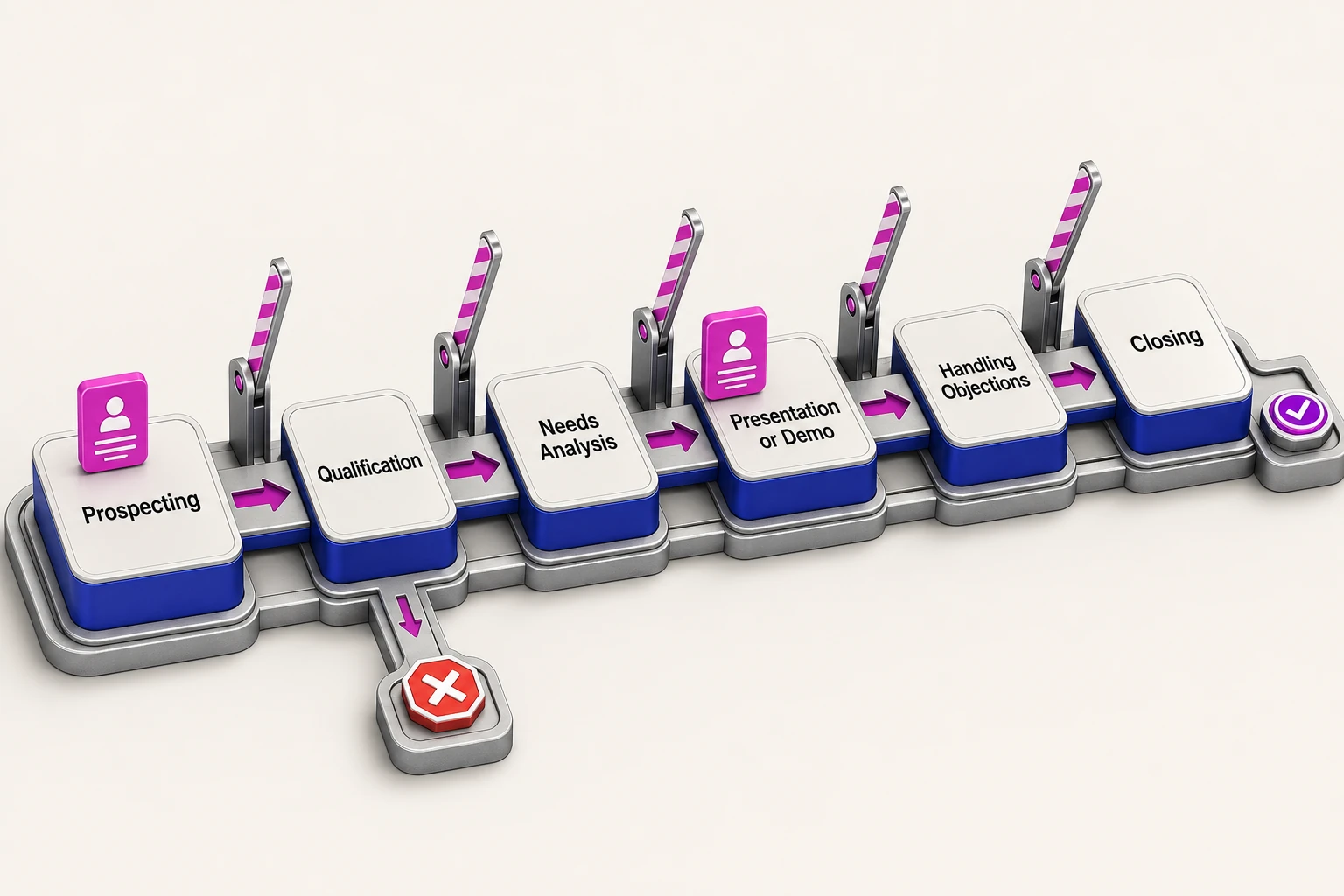
A sales process becomes useful when stages mean more than completed activity. In this article, each step has a decision gate, which is the evidence that earns advancement to the next stage. That keeps sales professionals from treating a call, email, or demo as progress on its own. In plain terms, sales only moves forward when the buyer has shown something real, not when the rep has simply done the task.
That distinction is what turns a structured sales process into a reliable operating model. Teams need clear stage exits so managers can inspect deals, coach consistently, and see where momentum breaks instead of relying on activity-based stage labels. Step counts can vary because different frameworks split the same journey into larger or smaller parts. This article commits to a six-step model because it captures the major sales decisions without making the process too vague or too fragmented.
What a Sales Process Is and Why Teams Need Clear Stage Exits
A sales process is the shared sequence a sales team uses to move an opportunity from early contact to real commitment. The sequence matters, but the stage exit matters more. A well defined sales process does not say a deal moved forward because a rep sent an email or booked a meeting. It says the deal advanced because the buyer met a clear threshold, such as confirming need, fit, or next-step access. That is what makes the process inspectable instead of personal.
Without shared exits, sales stages can look orderly while the pipeline stays unreliable. One rep may advance a deal based on enthusiasm, while another waits for actual buying evidence. Clear stage exits give the team a common standard, which makes coaching, forecasting, and pipeline review more useful.
- Expose when a deal is busy but not qualified
- Create a shared standard for the sales team to judge readiness
- Show where the sales process is breaking instead of where activity is happening
- Make a stage in sales mean buyer progress, not rep effort alone
Why Sales Methodologies Count Steps Differently, and Why This Article Commits to Six
Sales methodologies count steps differently because they divide the same journey at different points. One framework may merge discovery and needs analysis, while another separates qualification, objections, and close readiness into distinct checkpoints. A typical sales process can therefore look shorter or longer without changing the underlying path from initial fit to commitment.
This article uses six steps because that model isolates the biggest gate decisions without adding unnecessary complexity. It gives sales teams a practical way to judge whether an opportunity has earned the next move. With that six-step model in place, the next section can walk through each stage and the evidence that advances it.
The 6-Step Sales Process That Turns Activity Into an Effective Sales Process
Once gate logic is clear, the key steps in the full sequence become easier to use. This 6 steps sales process moves from initial fit to buyer commitment, and each sales process step has one question behind it: has the opportunity earned the next investment of time? That is what makes it an effective sales process instead of a list of sales activities.
- 1Prospecting checks whether the account is worth pursuing.
- 2Qualification checks whether basic fit, need, and access are present.
- 3Needs analysis checks whether the buyer has confirmed a real problem and priority.
- 4Presentation or demo checks whether the solution clearly fits the buyer's use case.
- 5Handling objections checks whether the main concern is resolved or clearly bounded.
- 6Closing checks whether the buyer commits to a real next action or purchase.
Prospecting: Which Potential Customers Are Worth Pursuing
Prospecting decides whether an opportunity belongs in the pipeline at all. In plain terms, the stage only passes when potential customers look like a real fit, not when a rep finds a name, sends outreach, or logs activity. A full top-of-funnel can feel encouraging, but weak entry standards create poor sales outcomes later.
- The account matches the basic profile the team can serve well.
- There is a plausible problem the offer can address.
- The contact appears connected to a real business context, not just a list entry.
Qualification: What Must Be True Before a Lead Moves Forward
Qualification tests whether the opportunity deserves more time from sales. The gate is basic evidence of fit, need, and access. In simpler terms, interest alone is not enough. If the team cannot show the lead fits the offer, has a problem worth solving, and gives some path to a useful conversation, the deal should stay put or exit.
- The lead fits the customer profile at a basic level.
- A live need or pain point is visible, even if it is not fully defined yet.
- The rep has access to a person who can share context, influence the decision, or connect the team to the right stakeholder.
Needs Analysis: What the Buyer Must Confirm in Discovery
Needs analysis turns curiosity into buyer-validated context. The stage passes only when the buyer confirms the problem, its impact, and why it matters now. That translation matters because discovery is not a fact-finding exercise for its own sake. It is the point where the team learns whether the opportunity is tied to a meaningful business priority or just general interest.
- The buyer agrees there is a specific problem or pain point.
- The buyer can describe the effect on results, workflow, cost, or risk.
- The timing, urgency, or decision context suggests the issue matters enough to address.
Presentation or Demo: When the Solution Actually Fits
A presentation or demo only counts when it proves relevance. The presentation gate is not whether the seller showed features. It is whether the buyer can connect the offer to the use case already discussed. That keeps the conversation focused on fit, which is what moves a deal forward, rather than on generic interest created by a polished walkthrough.
- The examples or workflow shown map to the buyer's situation.
- The buyer can see how the offer addresses the confirmed problem.
- The next conversation is based on fit questions, not on basic confusion about what the solution does.
Handling Objections: Which Concerns Can Be Resolved
Handling objections is where the deal proves whether resistance is workable or fatal. In practical terms, the objection gate passes when the core concern is resolved, narrowed, or clearly scoped. Questions by themselves are normal. Unanswered blockers are not. If the buyer still sees a material problem with price, fit, timing, or risk, the opportunity has not earned advancement.
- The main objection has a clear answer, which the buyer accepts or agrees to evaluate.
- Any remaining concern is specific and limited, not vague resistance.
- Both sides understand what must happen next for the concern to stop blocking the deal.
Closing: the Commitment That Earns the Next Step
It is the final stage because it tests commitment, not sentiment. The closing gate passes when the buyer makes a concrete decision or agrees to a next action with real weight. In plain language, a positive call is not enough. The opportunity only moves when the buyer does something that changes the status of the deal.
- The buyer agrees to purchase, sign, schedule, approve, or complete another decision-bearing action.
- The next step has a clear owner and timing.
- The commitment reflects genuine readiness, which is why closing is the final stage of the sequence.
That distinction matters because the next sections focus on how early gates should screen live opportunities before time is spent in the wrong place.
How to Qualify Early Opportunities Before They Waste a Sales Call
The first three gates usually decide whether a sales call creates progress or just consumes valuable time. At this point in sales, the job is simple: advance only when there is enough evidence of fit, need, and context to justify the next conversation.
01If the account matches a plausible target and the rep can explain why, prospecting can continue.
Advance to the next gate with confidence because the opportunity has earned more attention.
Stop, stall, or rework the opportunity when interest is high but evidence is thin.
02If the lead shows basic fit, a real problem, and access to the buying process, qualification can move forward.
Advance to discovery because the contact looks like one of the qualified leads worth deeper work.
Tighten the questions before booking another sales call.
03If the discovery sales call produces clear pain, priority, and decision context, the opportunity can earn deeper sales effort.
Prepare later-stage evaluation only when the problem is understood well enough to support a recommendation.
Use the next sections to test each gate instead of rewarding activity alone.
Early-stage discipline keeps weak opportunities from disguising themselves as pipeline progress. Once those gates are real, later stages can focus on proving fit instead of repairing bad early judgments.
Prospecting for Ideal Customers
Prospecting works when reps start with ideal customers, the business can actually help, not just anyone in the target market with reachable contact data. In plain terms, this approach stage is about choosing accounts whose target audience, likely needs, and buying shape resemble the new customer profiles that tend to become new business. That is how teams surface high value accounts before time gets spent on the wrong conversations.
The Gate: You Can Name a Real Fit, Not Just a Contact
- The account matches the kind of company the team serves well, including the right company size.
- There is a credible reason to believe the account has the problem or use case the offer addresses.
- The rep can explain why this account belongs in the pipeline beyond job title or contact details.
- The contact appears connected to the account's buying motion, even if full qualification has not started yet.
What to Do Next to Improve Lead Quality
- Review closed-won accounts and note the traits that recur before outreach begins.
- Use market research to narrow which account types deserve first attention.
- Do thorough research on each target account before adding it to active prospecting.
- Remove segments that reply often but rarely become qualified opportunities.
- Tighten sourcing criteria until reps can explain fit in one sentence.
The Mistake That Fills the Pipeline With the Wrong Accounts
Warning: activity volume is a weak standard for prospect entry.
A pipeline distorts when reps treat lists, sends, or replies as proof that an account belongs there. The result is false progress at the top of the funnel.
Prospecting should only pass when there is a genuinely good-fit account. A reachable name without account logic does not meet the boundary.
Reset the gate to account fit first, then continue outreach. That protects later stages from weak inputs.
Lead Qualification Before Time-Consuming Discovery Starts
Lead qualification decides whether interest deserves deeper sales effort before the time consuming tasks begin. That matters most when marketing teams hand over marketing qualified leads that responded well but have not yet shown the signals of qualified leads or the right leads for a real opportunity. The screen is basic on purpose: fit, need, and access have to appear before discovery earns more time.
The Gate: the Lead Meets Basic Fit, Need, and Access Criteria
- Fit: the account still looks like one that the team can serve and win.
- Need: There is evidence of a problem worth solving, not just casual interest.
- Access: The conversation can reach or influence the relevant decision makers.
- Clarity: The rep can state why this lead should become one of the sales qualified leads instead of staying among early qualified leads.
- Next-step logic: A discovery meeting would gather new evidence, not repeat an introductory sales conversation.
What to Ask Before You Advance the Opportunity
Strong qualification questions reduce optimism bias before the opportunity gets more attention. Use the answers to test three things: whether the account still looks like a fit, whether the problem is real enough to matter now, and whether the conversation can reach someone who can influence a buying decision. If those signals stay thin, discovery will only create more activity, not better evidence.
- What problem is the team trying to solve right now?
- Why does this issue matter enough to address now instead of later?
- How is the problem affecting results, time, or risk today?
- Who will evaluate options or influence the decision?
- What has already been tried, and where did it fall short?
- What would make a deeper conversation worth both sides' time?
The Mistake That Confuses Interest With Qualification
Warning: responsiveness is not the same as buying readiness.
A quick reply, a downloaded resource, or an accepted meeting can signal curiosity without proving fit, need, or internal traction.
Qualification should stop when the contact is engaged but the buying case is still unclear.
Ask for evidence, not enthusiasm, before moving the opportunity forward.
The Discovery Sales Call That Reveals a Real Buying Problem
A discovery sales call should create a better understanding of what is happening, why it matters, and how the buyer will decide what to do next. In plain language, discovery is where sales earns the right to recommend anything at all. If that context stays vague, the next stage will rest on an assumption instead of evidence.
The Gate: You Understand Pain, Priority, and Decision Context
- Pain: the buyer can describe the problem or pain points in specific business terms.
- Priority: the buyer has explained why the issue matters now and what happens if it stays unresolved.
- Decision context: the rep understands who is involved, how choices will be judged, and what next step makes sense.
- Recommendation readiness: the team has enough discovery context to tailor a recommendation instead of guessing.
How to Run a Better Discovery Conversation
- 1Open with the business situation so the buyer can describe the current state in their own words.
- 2Clarify the problem by asking what is difficult, costly, delayed, or risky today.
- 3Probe for priority so urgency becomes visible instead of assumed.
- 4Map the decision context, including stakeholders, evaluation logic, and likely next steps.
- 5Reflect back what you heard before recommending anything. That helps build relationships because the buyer can confirm or correct the picture.
- 6Close by agreeing on the next conversation only if the discovery context is strong enough to support it. That kind of relationship building creates trust because progress is tied to understanding, not pressure.
The Mistake That Turns Discovery Into a Premature Pitch
Warning: a polished sales pitch can still be early.
When the rep shifts into a sales pitch or elevator pitch before the buyer has defined the problem, discovery loses trust and sales loses evidence.
Discovery should stay focused on the buyer's context until the case for change is clear.
Earn the right to recommend by understanding first. That is the bridge into later-stage proof, objections, and commitment.
How Opportunities Move Through the Sales Funnel and Toward Closing Deals
Later-stage activity can look healthy while the deal stays stuck. In a sales funnel, a demo, a follow-up, or a pricing question only counts as progress when the buyer proves fit, resolves real concerns, and moves closer to closing deals.
01If the buyer has agreed on the problem, its impact, and its priority, the deal can move into solution proof.
That is real stage movement because the buyer is confirming what changes next.
02If the buyer is only interested in learning more, the deal is active but not advancing.
That is false progress because activity is being mistaken for sales momentum.
03If concerns appear, the rep must decide whether they are clarifications or true blockers.
A core blocker must be resolved or scoped before the deal deserves another stage advance.
04If the buyer can name a clear next action with decision weight, the opportunity is moving toward commitment.
That is the point where late-stage sales activity becomes a valid closing signal.
Those gate standards are what make later-stage sales measurable instead of impression-based.
Needs Analysis: Confirm the Problem Before You Prescribe
Mid-stage deals usually slip when the rep starts solving before the buyer has confirmed what actually needs to change. Needs analysis creates a buyer-agreed problem by aligning the issue, its business impact, and its urgency in the buyer's own terms. In plain language, it makes sure both sides are working on the same problem before any recommendation appears. That shared definition gives the rest of the process a stable base.
The Gate: the Buyer Agrees on the Problem, Impact, and Priority
- The buyer can describe the problem clearly without the rep restating it for them.
- The buyer agrees on the impact, such as delay, risk, lost revenue, or wasted effort.
- The buyer treats the issue as important enough to address now, not someday.
- The agreed problem is specific enough to guide the next recommendation.
What Strong Reps Clarify Before They Present
- The outcome the buyer wants, so the presentation can stay tied to a real result.
- The constraints shaping the choice, including timing, budget, approvals, or workflow limits.
- The criteria the buyer will use to judge potential solutions.
- The gaps that still need clarification before the recommendation sounds credible.
The Mistake That Makes Later Objections Inevitable
Warning: prescribing before the buyer validates the problem creates avoidable friction later.
When the recommendation is not anchored to a buyer-confirmed issue, potential objections multiply around relevance, timing, and cost.
The problem is not resistance alone. It is that the deal moved forward without a stable reason to move.
Pause the pitch and recheck the buyer's view of the problem before adding more detail.
Presentation or Demo: Prove Fit Instead of Showing Features
A sales presentation should narrow the buyer's decision, not widen it with extra information. The job here is to show use-case fit by mapping the company offers to the buyer's agreed problem, desired outcome, and selection criteria. Put simply, the buyer should leave knowing why this sales step matters to their situation, not just what the product does. That is what turns interest into usable evidence.
The Gate: the Buyer Can Connect Your Offer to Their Use Case
- The buyer can explain how the product or service applies to their specific use case.
- The buyer can connect the offer to the outcome they said matters most.
- The buyer can see why the recommendation fits their criteria better than a generic option.
- The meeting ends with clearer fit, not just positive energy.
How to Present Without Losing Relevance
- 1Reopen the buyer's stated problem, priority, and criteria before showing anything, so the presentation starts from agreed context instead of rep assumptions.
- 2Lead with the part of the offer that serves the target buyer's main use case, because the first proof point should answer the buyer's biggest decision question.
- 3Translate each feature into a concrete outcome the buyer already said they want, which keeps the conversation tied to fit rather than product volume.
- 4Skip side paths that are interesting but not decision-relevant, even when they usually work well in a broader demo.
- 5Stop to confirm understanding before moving to the next proof point, so confusion does not get mistaken for agreement.
- 6End by checking whether the buyer can now judge fit more clearly and connect the recommendation to their next decision.
The Mistake That Turns a Demo Into an Unqualified Maybe
Warning: a broad demo can create attention without creating a buying decision.
When the rep shows too much, buyers often lose interest in the part that actually mattered to them.
A busy meeting is not evidence of fit. It can leave the deal no better qualified than before.
Trim the presentation to the few points that help the buyer make a real choice.
Handling Objections: Separate True Blockers From Routine Resistance
Objections are useful signals when the rep reads them correctly. Handling objections well means separating common sales objections that need clarification from concerns that expose weak fit, low priority, or a skipped gate. The goal is not to win an argument. It is to identify the core blocker and decide whether the deal can still move honestly.
01If the objection is about a detail the buyer may not understand yet.
The rep should clarify it before trying to defend the offer.
02If the objection points back to an unclear problem, shaky fit, or missing stakeholder input.
The deal should move backward for rework, not forward on optimism.
03If the concern is serious but narrow enough to contain.
The opportunity can advance once the blocker is explicitly scoped.
That keeps handling objections tied to sales judgment instead of reflex.
The Gate: the Core Concern Is Resolved or Explicitly Scoped
- The buyer and rep can name the core blocker clearly instead of speaking around it.
- The concern has been answered well enough that it no longer prevents a decision.
- If the issue cannot be fully removed, its limits and implications are explicit.
- The next step makes sense because the blocker is no longer ambiguous.
How to Respond Without Rushing the Buyer
- 1Ask the buyer to describe the concern in their own words before using any sales techniques, so you respond to their meaning rather than your first interpretation.
- 2Confirm whether the issue is about fit, timing, risk, price, or the prospect's concerns about change, because different objections call for different next moves.
- 3Answer the real concern directly, using the part of the case that matches it, instead of giving a broad defense that only sounds responsive.
- 4Check whether the answer reduced the blocker or only created polite agreement, since nodding is weaker evidence than a clearer buyer view.
- 5If the issue exposes a weak earlier stage, return to that point instead of forcing progress, and repair the gap before you try to advance again.
- 6Advance only when the buyer shows clearer understanding and lower decision friction, which is the point where sales can move honestly.
The Mistake That Treats Every Objection Like a Negotiation Tactic
Warning: a fast counter can hide the reason the buyer is hesitating.
When every objection is treated like bargaining, the rep can miss confusion, weak fit, or unresolved risk.
That mistake makes the conversation sound active while the deal stays fragile.
Slow down long enough to learn what the objection is actually protecting.
Closing: Ask for Commitment Only When the Decision Is Ready
Closing should test readiness, not create it. A decision-weighted commitment happens when the buyer is prepared to purchase or take a next step that carries real consequence, such as approval, review, or signature. In practical terms, the close should reveal whether the deal is ready to move, not whether the buyer is merely being polite. That distinction is what prevents late-stage false progress.
The Gate: the Buyer Commits to a Clear Next Action or Purchase
- The buyer makes a buying decision or agrees to a specific next step with an owner and timing.
- The next action has decision weight, such as approval, legal review, procurement, or purchase.
- The commitment is concrete enough that it is different from vague future conversations.
- The deal would clearly change state if the promised action happens.
What Helps You Advance Without Forcing the Close
A sales rep moves deals more cleanly by matching the ask to the buyer's actual decision state. That keeps momentum tied to evidence, not pressure.
- Ask for the smallest commitment that still changes the deal state.
- Tie the next step to the issue the buyer already agreed matters.
- Make the owner, timing, and purpose explicit before ending the conversation.
- Treat hesitation as information, then recheck fit or blockers instead of pushing harder.
The Mistake That Creates False Progress Right Before the Finish
Warning: repeated motion near the end of the deal can hide the absence of commitment.
A stream of follow up calls, friendly replies, and soft promises can make the opportunity look alive without changing its odds.
If no decision-weighted action exists, the deal is not actually advancing.
That is the standard the next section can turn into CRM stages, proof fields, and conversion signals.
How to Turn the 6-Step Model Into Pipeline Management That Supports Sales Goals
A gate-based model only helps a team when it lives inside pipeline management, not just in a rep’s judgment. In practice, that means the sales process and sales strategy have to show up as stage rules inside the sales pipeline so sales leaders can inspect progress against sales goals and improve the current sales process with evidence instead of opinion.
- 1Map each stage of the sales process to one CRM rule about what must be true before a deal advances.
- 2Define the proof that confirms movement so the sales pipeline reflects buyer progress, not rep activity.
- 3Track movement between stages to see where sales slows, where criteria are weak, and where coaching should focus next.
Map Each Step to a CRM Stage With One Exit Criterion
Stage names become useful when each one represents a real buyer milestone. A CRM stage should mark one decision point in the company's sales process, and each stage should have one exit criterion that shows the buyer is ready for the next conversation.
- 1List the six steps in the sales process in order and give each one a matching CRM stage name.
- 2Write one exit criterion for each stage in plain language, such as confirmed fit, confirmed problem, or agreed next action.
- 3Test the rule by asking whether a manager could review the record and reach the same decision without hearing the rep's explanation.
- 4Remove extra stage meanings. If a stage mixes prospecting, discovery, and proposal activity, split the logic until one stage signals one kind of progress.
- 5Use the finished rules in training materials so new reps learn how deals actually advance in a streamlined sales process. That can also reduce ramp up time because the system shows what counts before a handoff or review.
Define the Required Fields That Prove a Deal Can Advance
Required fields should capture the minimum evidence behind a stage change. Good sales tools make that proof easy to see in customer data, while bad forms reward data entry that records effort without proving anything about buyer progress.
| Stage example | Required proof field | What the field proves |
|---|---|---|
| Qualification | Fit summary | The account matches the defined customer profile |
| Discovery | Primary problem statement | The buyer described a real issue in specific terms |
| Needs analysis | Business impact note | The problem has clear consequences worth solving |
| Demo or presentation | Use-case match | The offer connects to the buyer's stated need |
| Objections | Core concern status | The main blocker was resolved or clearly scoped |
| Closing | Next action commitment | The buyer agreed to a purchase step or decision event |
Track Conversion Between Steps to Find Where Deals Stall
Once stages and proof fields are stable, conversion tracking shows whether the process works in the real world. Sales managers need sales data on how many deals move forward, stall, or drop so coaching connects to sales targets; machine learning can help later, but the first person to benefit is the manager who can finally see where the system leaks.
| Stage transition | What to watch | What a leak may mean |
|---|---|---|
| Prospecting to qualification | Share of new accounts that meet fit criteria | Targeting is too broad or the entry gate is too loose |
| Qualification to discovery | Share of qualified leads that reach a real conversation | Access to the right contact is weak or urgency is overstated |
| Discovery to needs analysis | Share of calls that uncover a defined problem | Reps are collecting surface interest instead of decision context |
| Demo to objections | Share of presentations that trigger serious evaluation | The presentation is relevant enough to surface real concerns |
| Objections to closing | Share of resolved concerns that reach commitment | Blockers were not truly resolved or the close came too early |
That pattern is the operating signal. The six gates can stay the same even when the proof threshold changes by sales context.
How to Adapt the 6-Step Model Across B2B, SaaS, Retail, and High-Ticket Sales
A standardized process can still flex. In sales, the six gates stay in the same order, but the evidence that earns movement changes with pace, buyer behavior, and risk. That is what keeps the model comparable across teams without turning it into a rigid script.
| Context | Pace of movement | Type of evidence | Stakeholder complexity | Proof threshold |
|---|---|---|---|---|
| B2B | Slower, with more review between gates | Discovery notes, business case, stakeholder alignment | Higher | Broad agreement across roles before advance |
| SaaS | Faster early movement, then proof through product use | Calls, trial behavior, product engagement, usage-based evidence | Moderate to high, depending on account size | Fit is shown by adoption, not interest alone |
| Retail | Compressed sales cycle, often within one interaction | Questions, product response, immediate purchase signals | Low | Fast confirmation that need, fit, and commitment are real |
| High-ticket | Deliberate movement with heavier validation at each gate | Detailed conversations, risk review, trust signals, decision clarity | Moderate to high | Stronger proof threshold before each next step |
The pattern is simple: keep the gates, adjust the proof. Teams do not need a different stage model for every motion. They need context-specific evidence standards that still let one framework hold together.
B2B Sales: More Stakeholders, Slower Gates
B2B deals usually slow down because more people shape the decision. The six gates still apply, but stakeholder complexity raises the bar for advancement. A rep is not looking for one excited contact. The rep needs evidence that the problem matters across roles, that access to decision makers is real, and that internal alignment is forming, before the sales opportunity moves ahead.
SaaS Sales: Fast Qualification, Proof Through Usage
SaaS teams often move through early qualification quickly, then let product behavior sharpen the next decisions. Usage-based evidence means the buyer shows fit through actions such as activation, repeat use, or team adoption, not just positive talk on a call. In plain terms, the product becomes part of the proof. The six-stage sales structure stays intact, but evidence can come from both conversation and behavior.
Retail Sales: Shorter Cycles, Faster Commitment Signals
Retail compresses the same logic into a much shorter window. A compressed sales cycle can move from first interest to commitment in minutes, so the gates show up as quick checks: clear need, visible fit, buying intent, and a real next action. Strong service still matters because satisfied customers drive repeat business and create more room for cross selling. The process is faster, but the signals still need to be real.
High-Ticket Sales: Higher Risk, Heavier Validation
High-ticket decisions carry more financial and organizational risk, so every gate needs a stronger proof threshold. The sequence does not change, but validation gets heavier: the buyer must trust the seller, understand the impact, and feel confident that the decision will hold up internally. That usually makes sales slower and more deliberate. Flexible discipline is the goal, because the same six gates work best when each team adjusts evidence standards to fit its own environment.